

 English
 русский
 Español
 عربى
عربىDon't hesitate to send a message


Industry News
Home / News / Industry News / Extension Cord Gauge Chart: How to Match Wire Size to Amps, Length, and Load
Extension Cord Gauge Chart: How to Match Wire Size to Amps, Length, and Load
Content
- 1 What Is an Extension Cord Gauge Chart and Why It Matters
- 2 Understanding AWG: How Wire Gauge Works
- 3 Extension Cord Gauge Chart: Wire Size vs Amps vs Length
- 4 How Cord Length Affects Current Capacity
- 5 Choosing the Right Gauge: Step-by-Step Process
- 6 Voltage Drop: What It Means for Tools and Appliances
- 7 Indoor Cords, Outdoor Cords, and Heavy-Duty Cords
- 8 Jacket Types and Wire Count: Decoding Cord Markings
- 9 Common Appliances and Their Recommended Gauges
- 10 Safety Risks of Using the Wrong Gauge
- 11 Buying Quality Extension Cords That Match the Chart
- 12 When to Step Up One Gauge Size
- 13 Testing and Certifications: What to Look For in an Extension Cord
- 14 Extension Cord Gauge Chart in Daily Practice
- 15 Final Recommendations: Use the Chart Every Time
On a job site, a contractor plugs a 15-amp table saw into a 100-foot 16-gauge extension cord. The saw starts slowly, labors under load, and the cord jacket feels warm after a few minutes. None of this should be surprising: the wire gauge is simply too small for that length and the current the saw draws. A quick look at an extension cord gauge chart would have told the contractor to use 12 AWG for that run, and the saw would have cut cleanly without the cord heating up.
The extension cord gauge chart exists for this exact reason. It translates the relationship between wire thickness, current draw, and cord length into a simple recommendation. Overlooking it is one of the most common electrical mistakes in workshops, construction sites, and homes. A cord that is too thin does not just cause poor performance; it creates heat, and heat in an electrical conductor is the first step toward melted insulation, tripped breakers, and fire.
The conclusion is straightforward before any math begins: always select an extension cord using three numbers, the amperage of the device, the distance from the outlet to the device, and the wire gauge of the cord. The chart brings those three numbers together so you never have to guess.
What Is an Extension Cord Gauge Chart and Why It Matters
An extension cord gauge chart is a reference table that matches the current draw of an electrical device, measured in amps, against the length of the cord run and tells you the minimum wire gauge required for that combination. It is the most direct way to avoid an undersized cord. The chart assumes standard 120-volt household circuits and copper conductors, which cover the vast majority of residential and light commercial extension cord use.
Why does it matter so much? Every conductor creates resistance as current flows through it. Thinner wire produces more resistance than thicker wire of the same material and length. More resistance means more voltage drop and more heat. When a cord is undersized, the device at the far end receives less voltage than it needs, its motor draws more current to compensate, and the cord itself begins to warm. That chain slowly damages the device, the cord, and whatever the cord touches.
The chart also matters for performance. A circular saw on an undersized cord feels weak and tends to bog down during heavy cuts. A compressor may struggle to start. A space heater on a long, thin cord delivers noticeably less heat. These are not vague mysteries; they are voltage drop and resistance working exactly as physics predicts. The chart is the engineering shortcut that lets anyone avoid these issues without owning a multimeter or a handbook of wire resistance tables.
It matters for purchasing as well. When you buy an extension cord, the gauge is printed on the jacket, for example "16/3" or "12 AWG," so the information is available at the point of sale. Knowing how to read that marking against the chart, rather than looking only at the plug or the color of the jacket, is the difference between a safe and informed purchase and a gamble.
Understanding AWG: How Wire Gauge Works
Wire gauge is standardized in North America through the American Wire Gauge system, abbreviated AWG. The system assigns a number to each standard wire diameter. The key point is counterintuitive at first: the lower the AWG number, the thicker the wire. A 10 AWG cord has a larger conductor than a 14 AWG cord, and a 16 AWG cord is thinner still.
Most household, workshop, and light commercial extension cords fall in the 10 to 18 AWG range. Here is how the common sizes compare:
- 18 AWG: the lightest cord commonly sold. Suitable for lamps, small fans, phone chargers, and other loads under about 7 to 10 amps at short lengths.
- 16 AWG: a step up, suitable for low-to-moderate loads such as handheld power tools, radios, and small appliances over short runs.
- 14 AWG: the minimum many professionals recommend for larger power tools and appliances drawing 10 to 15 amps.
- 12 AWG: handles 15 to 20 amp loads and is the most common choice for workshop tools, space heaters, and long exterior runs.
- 10 AWG: the heavy-duty class, used for 20 to 30 amp loads, RV hookups, and long runs to high-current equipment.
The number after the gauge, such as the "3" in "12/3," refers to the number of conductors inside the jacket. A 12/3 cord has three 12-gauge conductors: a black hot wire, a white neutral wire, and a green ground wire. A 12/2 cord has only two conductors and no ground, which is why the grounding status must always be checked before purchase.
It is worth repeating that the thickness of the outer insulation can make a thin cord look thick. Some inexpensive cords use bulky, soft insulation so they appear heavy-duty, while the copper inside is actually 16 or 18 AWG. The only honest way to know the gauge is to read the marking printed on the jacket. If the cord has no marking, treat it as unknown, size it conservatively, and ideally replace it.
Extension Cord Gauge Chart: Wire Size vs Amps vs Length
The following chart combines the two variables that matter most, current in amps and distance in feet, and gives the minimum recommended wire gauge for each combination. The values assume a 120-volt circuit, copper conductors, and a voltage drop limit suitable for motor-driven tools and general appliances.
| Amp Load | 25 ft | 50 ft | 100 ft | 150 ft |
|---|---|---|---|---|
| 5-10 A | 18 AWG | 16 AWG | 14 AWG | 12 AWG |
| 10-13 A | 16 AWG | 14 AWG | 12 AWG | 10 AWG |
| 13-15 A | 14 AWG | 12 AWG | 12 AWG | 10 AWG |
| 15-20 A | 12 AWG | 12 AWG | 10 AWG | 8 AWG |
| 20-25 A | 10 AWG | 10 AWG | 10 AWG | 8 AWG |
| 25-30 A | 10 AWG | 10 AWG | 8 AWG | 6 AWG |
To read the chart, find the amp requirement of the device, then move across to the column that matches your cord run. The number in that cell is the minimum gauge you should buy. If you land in a gray zone, for example a 14-amp tool at 75 feet, choose the thicker option from the row above or the column to the right. Going one gauge thicker than the chart calls for is never wasted money.
The chart is intentionally a simplification. It does not account for extreme ambient temperatures, tightly coiled cords, or devices with unusually high inrush current. It is a safe starting point for normal conditions. When any of those factors apply, the correct response is to move one or two gauge sizes up.
How Cord Length Affects Current Capacity
The length of an extension cord matters nearly as much as the gauge. Resistance grows in direct proportion to conductor length. A 100-foot cord has roughly twice the resistance of a 50-foot cord made from the same gauge. Doubling the resistance means doubling the voltage drop at a fixed current, which leaves less voltage for the tool and produces more heat along the wire.
This is why the same saw that performs well on a 25-foot 14 AWG cord will dramatically underperform at 100 feet on the same cord. The motor ends up operating below its rated voltage. It draws more current as it tries to compensate, the extra current generates additional heat, and the cycle continues until the tool's thermal protection shuts it down, or until the tool is damaged.
Motors are especially sensitive to undervoltage. A circular saw, table saw, air compressor, or shop vacuum depends on voltage to deliver torque and keep windings within their operating temperature. Prolonged undervoltage at high current is a well-documented cause of premature motor failure. This is not a theoretical complaint; contractors and DIY users frequently blame the tool, the brand, or the power outlet before realizing that the extension cord was the bottleneck all along.
A practical rule of thumb: for every additional 50 feet of cord length, move up one gauge size. If a 10-amp load needs 14 AWG at 50 feet, it needs 12 AWG at 100 feet and 10 AWG at 150 feet. The pattern appears throughout the chart and is worth keeping in mind even when you are not looking at it.
Choosing the Right Gauge: Step-by-Step Process
Applying the chart is straightforward when you follow a structured approach. Here is the sequence that works for homeowners and professionals alike.
Step 1: Identify the amperage rating of the device
Every appliance and power tool has a nameplate or a metal tag listing its electrical ratings. Look for "A" or "amps" beside a number. A table saw may read 15 A, a shop vacuum 12 A, a space heater 12.5 A. If the device lists watts rather than amps, divide watts by volts: a 1,500-watt heater on a 120-volt circuit draws 12.5 amps. If the nameplate is missing, use the wattage printed on the device body and make a conservative estimate.
Step 2: Measure the true cord run
Measure from the wall outlet to the device, not simply to the spot where you plan to lay the cord. Include any built-in appliance cord already attached to the device; that built-in portion counts toward the total distance from the wall to the tool.
Step 3: Find the intersection on the chart
With amps on one axis and distance on the other, the chart gives the minimum gauge. Write it down and take it to the store. A 13-amp planer running at 75 feet needs a 12 AWG cord, not the 16 AWG cord that may look similar on the shelf at a distance.
Step 4: Add a safety margin for high-starting-current tools
Some devices pull two to three times their running current during startup. Compressors, table saws, and refrigerated appliances are typical examples. The nameplate amp rating does not reveal this. For such tools, choose one gauge thicker than the chart suggests, and use a 12 AWG cord even when 14 AWG appears adequate, so the motor receives enough voltage to start reliably.
Step 5: Verify the cord's rating and grounding
After selecting a gauge, confirm the cord is rated for the ampacity you need. The jacket should list the conductor gauge and usually a voltage rating. If the tool has a three-prong grounded plug, the cord must have a grounding conductor across its full length. Never combine a two-prong cord with a three-prong tool, and avoid adapters that defeat the ground.
Voltage Drop: What It Means for Tools and Appliances
Voltage drop is the loss of electrical pressure that occurs as current flows through wire. It is the physical reason that thin and long cords are problematic. A 120-volt circuit may leave the panel at 120 volts but arrive at the tool far lower if the extension cord is undersized or overly long.
Electrical engineering practice generally recommends keeping voltage drop below 3 percent for branch circuits feeding sensitive equipment, and up to 5 percent for general loads. On a 120-volt system, 3 percent equals 3.6 volts. Losing those 3.6 volts may not seem significant. For a motor already running near its limits, however, the loss reduces starting torque, increases running current, and shortens motor life.
The practical effects depend on what is being powered. Lamps and phone chargers tolerate far more voltage drop because their internal power supplies accept wide input ranges. Heating devices such as space heaters simply make less heat when voltage drops. But tools with universal motors, such as saws, grinders, and routers, operate within a narrow electrical window. Their motors are designed for a specific voltage, and an extended drop damages brushes, increases winding temperature, and accelerates wear.
The gauge chart is where this risk is managed. Each cell in the table is selected so that the voltage at the load stays within a practical range for the stated amperage and distance. Stay inside the chart and the voltage remains at a level most devices tolerate. Step outside the chart and the voltage at the far end dips, a decline you will feel, hear, and eventually see in damaged equipment.
Indoor Cords, Outdoor Cords, and Heavy-Duty Cords
Gauge is only part of the story. The jacket, the outer insulation, determines where the cord is safe to use. The wrong jacket in the wrong environment can fail even when the gauge is correct.
Indoor cords
Basic household extension cords use a lightweight vinyl jacket such as SPT or SVT. They suit lamps, electronics, and small appliances indoors, but they are not built for moisture, sunlight, or physical abuse. The jacket will harden, crack, and eventually expose conductors if left outdoors or in heavy foot traffic.
Outdoor cords
Outdoor extension cords carry a tougher, weather-resistant jacket, indicated by the letter W in the marking, as in SJTW or SJTOW. The jacket resists water, UV exposure, and temperature swings. Outdoor cords are available in the same gauges as indoor cords, but their heavier jacket protects the conductors from conditions that quickly destroy a cheap indoor cord. For any run exposed to sunlight, moisture, or traffic, choose a marked outdoor cord. An example of a well-built outdoor cord is the FP672 durable orange outdoor extension cord with grounded protection, which pairs a thick jacket with a grounded design for exterior service.
Heavy-duty and industrial cords
On construction sites and in severe service, heavy-duty cords use oil-resistant thermoset or thermoplastic rubber jackets, commonly marked SJTOW or SOOW. These cords tolerate abrasion, oil, and repeated flexing, which is why they are the default on professional job sites. The terms "heavy-duty" and "professional grade" are meaningful here because the jacket material absorbs punishment that PVC cannot.
The cord category does not change the gauge math. A 12 AWG indoor cord and a 12 AWG outdoor cord carry identical current, but the outdoor cord stays functional when weather and abuse arrive. Gauge handles electrical capability; jacket handles environmental survival. Both must match the job.
Jacket Types and Wire Count: Decoding Cord Markings
When you pick up an extension cord, the text printed on the jacket tells you exactly what you are holding. Decoding it removes the guesswork from a purchase.
A typical marking reads "SJTW 16/3 125V." The letters and numbers break down as follows:
- S designates hard-service cord, rated for the general wear associated with household and light industrial use.
- T designates thermoplastic insulation, a heat- and moisture-resistant PVC compound.
- W designates weather resistance, the marker for outdoor use.
- J, when present, indicates a lighter-duty jacket within the S family, as in SJ.
- O indicates an oil-resistant jacket; SOOW includes double oil resistance.
The number after the slash indicates conductor count. The "3" in 16/3 means live, neutral, and ground conductors are present. The leading number is the gauge.
When a cord lists voltage and ampacity, that rating defines the maximum safe operating conditions. A cord marked "125V / 10A" is light duty no matter how thick the jacket feels. A cord marked "12 AWG / 20A" belongs in the higher capacity class the chart requires. The printed marking is the only reliable reference because a cord's physical diameter can be increased by insulation without adding copper.
Wire count is also a safety issue. Two-conductor cords have no ground path and should be used only with double-insulated tools or equipment designed for two-prong connections. Three-conductor cords include the ground necessary for any device with a grounded plug. If your tool has three prongs, your extension cord must provide a continuously grounded path.
Common Appliances and Their Recommended Gauges
Seeing the chart applied to everyday tools makes it easier to internalize. Here are typical scenarios and the gauges they require.
Lamps, phone chargers, and small electronics
These loads rarely exceed 2 amps, which is why light-duty 18 AWG cords are everywhere. For a floor lamp or charger, 18 AWG at ordinary household distances is adequate. The danger begins when the same cord is asked to carry a space heater or a saw.
Handheld power tools
Drills, sanders, and angle grinders draw 5 to 10 amps. A 16 AWG cord is acceptable up to 25 feet; at 50 feet, 14 AWG is a safer choice. For circular saws and routers operating near the top of that range, select 14 AWG for short runs and 12 AWG beyond 50 feet.
Stationary workshop tools
Table saws, planers, band saws, and dust collectors commonly draw 12 to 15 amps and have motors sensitive to voltage drop. That places them on the 14 AWG line for short runs and on the 12 AWG line at about 50 feet. A 100-foot run to a 15-amp table saw is a 10 AWG situation.
Heating appliances
Space heaters and window air conditioners run for hours at a time, not minutes. A 1,500-watt heater draws 12.5 amps continuously, so the risk of undersizing is higher. Use a 12 AWG cord for runs beyond 25 feet and never connect a heater through a multi-outlet cord rated below its load.
Outdoor and high-current equipment
Electric lawn mowers, pressure washers, and RV hookups routinely draw 15 to 30 amps. At short distances, 10 AWG or 12 AWG is typical. For a standard 120-volt RV connection, a 10 AWG cord is the right class because continuous loads may run near 20 amps.
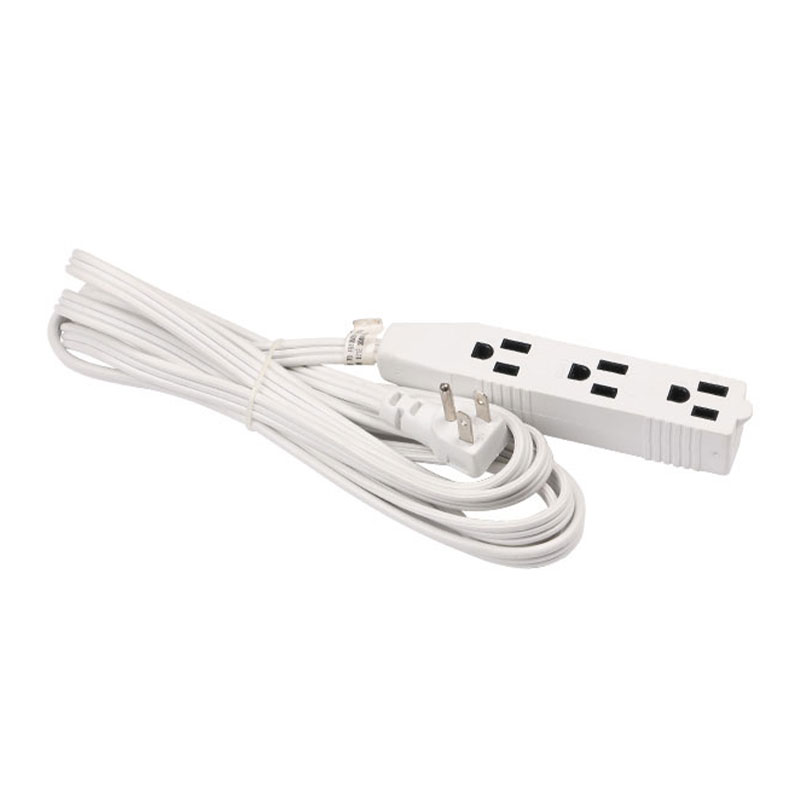
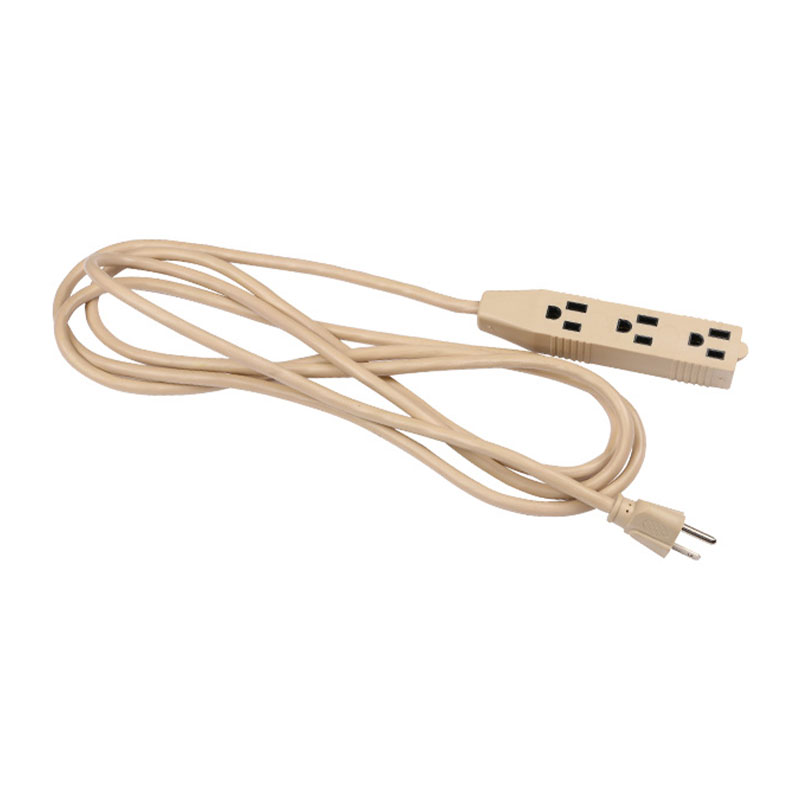
The pattern is consistent: the tools that work hardest need the most copper. Selecting extension cords by appearance is exactly how mismatches happen. Selecting by gauge, with the chart in hand, keeps every tool running as rated. For a practical view of how these gauge recommendations apply across a wider range of equipment, you can review extension cords for various electrical appliances in our application reference. For a household space feeding several devices at once, the American standard household multi-outlet extension cords distribute one circuit to multiple receptacles while maintaining the grounding and gauge needed for moderate loads.
Safety Risks of Using the Wrong Gauge
If underperformance were the only consequence, an undersized cord would be a simple inconvenience. It is not. The safety risks are real, cumulative, and often invisible until they turn into a failure.
The first risk is overheating. When a conductor carries more current than its gauge can safely handle, the wire temperature rises. An 18 AWG cord carrying 15 amps runs noticeably hot. The heat softens PVC insulation, degrades it over time, and makes it prone to cracking, shorting, and arcing. An overheated cord beneath a rug, coiled on a wood floor, or passing through a doorway presents a fire hazard in every one of those positions.
The second risk is damage to connected equipment. A voltage-starved motor runs hotter and wears faster. Repeated low-voltage starting can burn out a compressor motor in a season or two. The symptom may not appear while the motor is new, but the shortened lifetime is the price of the mismatch.
The third risk is failure of breakers, receptacles, and plugs. An undersized cord extends the time that current flows above the designed level. The breaker protects the wall wiring, but it was never meant to compensate for a poor extension cord selection. The weakest link in the circuit concentrates the failure, often at the receptacle contacts, the plug blades, or the cord terminations.
There is no clever trick to avoid these risks. Confirm the amp draw, measure the length, choose the gauge from the chart, and inspect cords regularly for damage. A cord that feels warm to the touch under normal load is too small for the job. That single rule prevents most extension cord accidents.
Buying Quality Extension Cords That Match the Chart
Once the gauge is decided, the remaining question is which cord to buy. Quality determines whether a cord performs as its marking promises, because conductor metal, jacket material, connector design, and factory testing all play a role. This is especially relevant for distributors, importers, and businesses that source extension cords in quantity, because every unit carries the manufacturer's responsibility for electrical safety.
A reputable manufacturer will be transparent about conductor gauge, insulation material, plug and socket construction, and applicable standards. When a supplier specializes in both indoor and outdoor power cords, you can match the chart to a specific product line instead of accepting a generic one-size-fits-all solution.
The construction details that separate a premium cord from a bargain cord include the quality of the conductor copper, the wall thickness of the jacket, the fit between plug blades and receptacle contacts, and the strain relief where the cable enters each connector. A cord that flexes too easily at its ends will eventually develop an internal break, which is why heavy-use cords carry molded or reinforced strain relief.
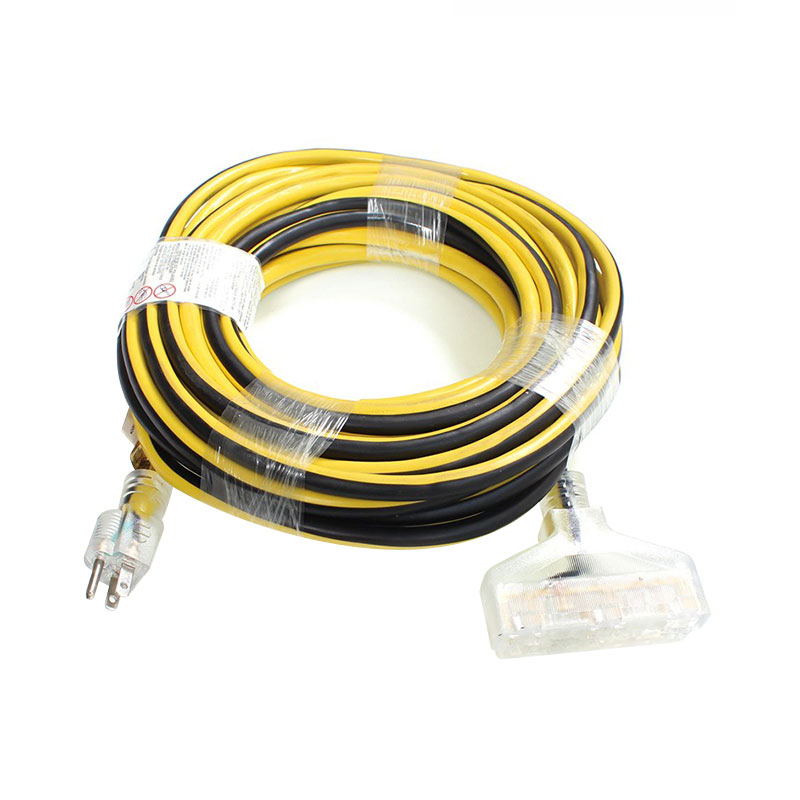
For job sites and temporary installations, the heavy-duty multi-outlet extension cord for temporary indoor and outdoor power sits between a fixed installation and a movable feed. It is built to be repositioned, walked on, and exposed to weather while still delivering full rated current to multiple tools at once. These are the cords that survive when a site layout changes daily, and their gauge and jacket specifications should be verified against the chart just as carefully as any other cord.
When to Step Up One Gauge Size
There are situations where the chart's minimum recommendation is not the wisest choice. Recognizing them prevents buying a cord that is technically adequate but practically marginal.
Move up one gauge size when:
- The tool has high starting current, such as a large compressor, table saw, or refrigerated appliance.
- The cord is likely to stay coiled during use. Coiled cords trap heat more easily than straight runs.
- The cord will sit in direct sunlight for extended periods. High ambient temperature lowers a cable's current rating.
- The branch circuit is already near its rated load. Adding an extension cord to a heavily loaded circuit worsens voltage drop for the entire chain.
- The cord passes through hidden spaces, under carpets, or in confined paths where heat cannot dissipate, even if the cord is sold as a temporary product.
Moving one gauge from 16 to 14 AWG, or 14 to 12 AWG, adds little to the purchase price. The gain in performance and safety is far greater. When a load falls exactly on a boundary, such as 13 amps at exactly 50 feet, choose the larger cell. The chart is a minimum guideline, not a target.
Testing and Certifications: What to Look For in an Extension Cord
Gauge, jacket, and conductor count are the beginning. Certifications are what verify that a finished cord meets established safety and performance criteria.
In North America, look for a listing mark from a recognized testing laboratory such as UL or ETL. The mark indicates the product has been tested for durability, heat resistance, and current capacity. For export and industrial buyers, IEC standards and country-specific approvals such as CE, VDE, or SAA may be required depending on the destination market. A manufacturer that ships worldwide should be able to supply the certification documentation for its line of extension cords.
A cord with a certification mark but no legible gauge marking is still a red flag. The marking should be clear, permanent, and repeated along the jacket at regular intervals. If you cannot read the gauge, you cannot verify the cord against the chart, and you have no way to confirm it is appropriate for the appliance you intend to plug in.
Mechanical quality matters beyond the label. Plug blades should be solid and free of burrs. Sockets should hold a plug firmly without wobble. The strain relief at each end should be molded or otherwise reinforced, not a loose insertion that flexes under light pressure. A cord that bends too easily at its ends will eventually develop an internal break.
For organizations sourcing cords in volume, inspection and testing carry additional weight. The difference between a production run of certified cords and an uncertified batch is the difference between a stable product line and a recall. Working with a manufacturer gives you access to conductor resistance testing, insulation integrity checks, and connector pull-out verification before shipment, and those records can accompany the order. The same attention you apply to gauge charts should be applied to validation and quality documentation when choosing supply partners. For fixed equipment and machinery supply lines, the same logic extends to the cable that connects the machine itself; our industrial power cord selection guide explains how those decisions scale to plant and industrial environments.
Extension Cord Gauge Chart in Daily Practice
Reading the chart is valuable only when it becomes a habit. Here is how experienced contractors and buyers use it every day.
Keep a copy of the chart on your phone or in your toolkit. When you stand in front of a display of cords, you want the table in view, not a vague memory of something you read once. The chart does not need to be memorized; it needs to be accessible.
Sort cords by gauge rather than by color or length. Many workshops label each cord at the plug with a marker, a tag, or colored heat-shrink tubing. When all cords look the same, the only way to know which one you have in hand is how it is labeled. The minutes spent labeling are paid back every time you avoid hauling the wrong cord to the far corner of a site.
Buy longer cords only when the run requires it. A longer cord is heavier, more costly, and lowers voltage drop performance at the same gauge. If most of your work sits within 50 feet of an outlet, a pair of 50-foot cords in different gauges is more useful than one 100-foot cord that is marginal for the loads you carry.
Inspect connections before every use. Frayed jackets, cracked insulation, bent blades, and loose sockets are reasons to retire a cord immediately. Electrical tape is not a repair. A cord damaged near the plug can create internal arcs, and no gauge selection can protect against a physical failure.
Final Recommendations: Use the Chart Every Time
The extension cord gauge chart is not a niche reference for electricians. It is the basic tool anyone needs to avoid the three most common extension cord mistakes: buying by appearance instead of gauge, running too much distance on too little copper, and using an indoor cord outdoors.
Before each purchase, write down three numbers: amps at the device, distance to the outlet, and the gauge of the cord you are considering. Compare them on the chart. If the gauge is equal to or thicker than the recommended cell, and the jacket fits the environment, the purchase is correct. If not, step up one gauge or shorten the run.
The small cost difference between a lighter and a heavier cord is one of the cheapest investments in electrical safety available. A 12 AWG cord costs more than a 16 AWG cord. In return, it keeps tools at full power, keeps jackets cool, and extends the life of the cord and the connected equipment.
For business professionals selecting cords for export, retail, or industrial supply, the same chart remains the foundation, but the standard of proof should be higher. Choose a supplier that documents conductor size, uses proper insulation material, tests finished products, and issues the correct certifications for each destination market. The full extension cord range, and the applications it covers, is designed around that principle: gauge, jacket, and connector must match the job they are asked to do.
- RELATED PRODUCTS
Latest Updates
Provide You With The Latest Enterprise
Provide You With The Latest Enterprise
and Industry News.
We will continue to focus on the intelligent temperature control field and serve global users with technical concepts of "safer, more energy-efficient and more environmentally friendly".
-
Industry News
How to select the right power cord for your industrial equipment
Power Cord Internal Construction and Scientific Mysteries Deeply understanding the Power Cord requires starting with microscopic materials science and physics. The design of each internal layer is a calculated balance be...
09
Feb 2026 -
Industry News
What Is an Immersion Water Heater and How Does It Work?
Definition of an Immersion Water Heater Overview of Immersion Water Heaters An Immersion Water Heater is a type of electric heating device specifically designed to heat water directly by immersing its heating element int...
09
Feb 2026 -
Industry News
Are Immersion Water Heaters Safe? 5 Critical Safety Tips You Need to Know
1. Always Ensure the Heater is Fully Submerged in Water Before Turning It On Why Submerging the Heater is Crucial for Safety An immersion water heater is designed to work by transferring electrical energy into heat, whic...
11
Feb 2026 -
Industry News
The Ultimate Guide to Immersion Water Heaters: From Portable Heating to Safety Best Practices
Scenario-Based Applications: How to Choose the Right Heating Solution? Is a Floating Immersion Water Heater Really a Winter Bathing Essential? Maintaining water temperature in large containers like bathtubs or big bucket...
11
Feb 2026
Be the First to Know
For exclusive deals and latest offers, sign up by entering your email address below.
-
Provide one-stop service from design optimization, process improvement to volume delivery.
-
Quick Links
Home Products About Us Advantages Application News Contact Us -
Products Categories
Immersion Water Heater Extension Cord Power Strip Power Cord Heating Element Hot Plate Magnesium Anode Rod Electrical Water Heater Stem Thermostat -
Contact Information
Add : Feida Industrial Park , Houxiang Town, Danyang City , Jiangsu Province ,China
E-mail: gm@cnfpdq.com
Tel: +86-13306103666
Fax: +86-511-86321126
Copyright © 2025 by Danyang Feipeng Electrical Appliance Co., Ltd. All Rights Reserved.
 Custom Electric Heater Components Manufacturers
Custom Electric Heater Components Manufacturers