

 English
 русский
 Español
 عربى
عربىDon't hesitate to send a message

OSHA Extension Cord Rules: What Inspectors Flag and How to Stay Compliant
Content
- 1 The Short Answer: What OSHA Actually Requires of Every Extension Cord
- 2 General Industry and Construction Are Not the Same Rulebook
- 3 The Inspection Rule That Produces the Most Citations
- 4 Five Uses OSHA Flatly Prohibits
- 5 Splicing, Repair, and the Limits of Tape
- 6 GFCI Requirements and the Assured Equipment Grounding Conductor Program
- 7 Gauge, Ampacity, and Length: The Physics Behind the Rule
- 8 Jacket Codes, Indoor Versus Outdoor, and Wet Locations
- 9 Power Strips and Daisy Chains: The Most Common Misunderstanding
- 10 Strain Relief, Plugs, Adapters, and Physical Protection
- 11 Penalties, Training, and the Paperwork That Decides Outcomes
- 12 Sourcing Compliant Cords: A Buyer's Checklist
- 13 Building a Cord Program That Survives a Walkthrough
The citation took less than four minutes to write. A compliance officer walking a mechanical contractor's site stopped at a temporary panel where a 100-foot, 16-gauge orange cord ran from a wall receptacle, passed through a fire door that could no longer close, disappeared under a rubber mat, and reappeared at a three-way adapter feeding two more cords and a power strip. The electrician who set it up had been doing it the same way for eleven years, and nobody on site thought any part of it was unusual.
That is the nature of extension cord enforcement. The equipment is cheap, ubiquitous, and treated as an accessory rather than as electrical equipment subject to a regulatory framework. Yet cords are involved in a disproportionate number of electrical injuries, and the standards that govern them are cited often enough that "Electrical, Wiring Methods, Components and Equipment" routinely sits high on OSHA's annual list of most-frequently-cited standards in both construction and general industry.
Here is the short answer before the detail: OSHA does not have a single, self-contained "extension cord standard." The rules are spread across several sections of 29 CFR Part 1910 for general industry and Part 1926 Subpart K for construction, plus related provisions in 1910.303 through 1910.335. When an inspector looks at a cord, they are effectively asking three questions. Is this cord approved and suitable for where it is being used? Is it undamaged, and has someone actually looked at it? And is it being used in a way the rule permits, or has it become permanent wiring, a spliced mess, or a daisy chain? Everything below is an elaboration on those three questions, plus the practical buying and specification decisions that determine whether you can answer them honestly.
The Short Answer: What OSHA Actually Requires of Every Extension Cord
Stripped of the paragraph numbers, the obligations fall into six buckets. The first is suitability: equipment must be approved and appropriate for the conditions of use and the location. The second is inspection: cord-and-plug-connected equipment and flexible cord sets must be visually inspected before use on any shift. The third is removal: anything defective or damaged enough to possibly injure an employee is out of service until repaired and tested. The fourth is prohibited use: cords cannot substitute for fixed wiring, run through holes or doorways, attach to building surfaces, or be concealed behind walls, ceilings and floors. The fifth is construction and repair: no splices or taps in ordinary cords, and strain relief at every connection. The sixth is ground-fault protection, which applies specifically to temporary receptacles on construction sites.
Notice what is not on that list. There is no OSHA requirement that a cord be a particular color, no maximum length expressed in feet, and no rule that says "12-gauge or heavier." Those numbers come from the listing standards and the electrical code, and they enter OSHA compliance indirectly: a cord that is too small for its load or too long for its gauge becomes a recognized hazard, and recognized hazards are citable under the general equipment provisions.
| Obligation | Primary citation | Field test |
|---|---|---|
| Approved and suitable for the conditions of use | 1910.303(b)(1); 1910.305(g)(1) | Does the jacket code and rating match the environment, voltage, and load? |
| Visual inspection before use on any shift | 1910.334(a)(2)(i) | Can the person using it describe what they checked this morning? |
| Remove damaged equipment from service | 1910.334(a)(2)(ii) | Is the damaged cord physically destroyed, or is it back in the truck? |
| No use as a substitute for fixed wiring | 1910.305(g)(1)(iii) | Has this cord been in the same doorway for six months? |
| Continuous lengths only, no splices or taps | 1910.305(g)(2)(ii) | Is there any tape, heat shrink, or twisted splice on the run? |
| Strain relief at devices and fittings | 1910.305(g)(2)(iii) | Does tugging the cord pull on the terminals inside the plug? |
| GFCI protection on temporary construction receptacles | 1926.404(b)(1)(ii) | Is every 120-volt, 15- and 20-amp temporary receptacle on a Class A GFCI? |
General Industry and Construction Are Not the Same Rulebook
The most common mistake made by safety managers who move between sectors is assuming the construction rules apply everywhere, or that the general industry rules are a looser version of the same thing. They overlap heavily but the differences matter.
General industry: 1910.334 sets the tone
In general industry, the anchor provision is 1910.334, "Portable electric equipment." It establishes the inspection regime, the removal-from-service requirement, the handling rules, and the grounding expectations for cord-and-plug-connected tools and cords used in factories, warehouses, shops, and commercial buildings. Around it sit 1910.305 for wiring methods — which is where the flexible cord rules live — and 1910.303 for the general requirement that electrical equipment be free from recognized hazards.
The practical consequence is that general industry enforcement tends to focus on suitability and maintenance. An inspector in a plant is more likely to ask why a cordset is taped, why a cord has been stapled along a wall, or why a bench grinder is powered through a cord that has been in place so long the jacket has gone hard and brittle.
Construction: ground-fault protection becomes mandatory
Construction adds an obligation that has no general industry equivalent in the same form. Under 1926.404(b)(1)(ii), all 120-volt, single-phase, 15- and 20-ampere receptacle outlets on a construction site that are not part of the permanent wiring of the building and are in use by employees must have approved ground-fault circuit interrupters for personnel protection. The cord itself is not the protected item — the receptacle is. But if your cord is plugged into a temporary spider box that lacks GFCI protection, you have a violation regardless of how good the cord is.
There is an alternative path: the assured equipment grounding conductor program. Employers who run an AEGCP instead of installing GFCIs must maintain a written description of the program, visually inspect cord sets and equipment before each day's use, and perform continuity tests on cord sets and receptacles at set intervals — cord sets at least every three months — with the testing done by a competent person and the results recorded. In practice, most contractors install GFCIs and treat the AEGCP as a fallback, because a paper program that is not actually executed is worse than no program at all: it converts an equipment problem into a documentation problem and, if an injury follows, into evidence of knowing noncompliance.
One more wrinkle worth knowing: roughly half the states operate their own OSHA-approved plans, and some are stricter than federal OSHA. California, for example, maintains its own flexible cord and cable rules in Title 8, including explicit provisions on splices and on pull at joints and terminals. If you operate in a state-plan state, check the state standard before you rely on the federal text.
The Inspection Rule That Produces the Most Citations
The single most useful sentence in the entire regulatory framework for cords is this one, from 1910.334(a)(2)(i): portable cord- and plug-connected equipment and flexible cord sets shall be visually inspected before use on any shift for external defects and for evidence of possible internal damage.
Two phrases in that sentence do the work. "Before use on any shift" means the inspection is a recurring event, not a one-time acceptance test. If you run two shifts, you need two inspections per day. "Evidence of possible internal damage" is broader than visible damage — a pinched or crushed outer jacket with intact insulation still qualifies, because the conductor inside may be compromised in a way the eye cannot confirm.
The standard also lists what to look for. External defects include loose parts, deformed or missing pins, and damage to the outer jacket or insulation. Internal damage indicators are things like a pinched or crushed jacket. There is one narrow exception: cords and equipment that remain connected once put in place and are not exposed to damage do not need to be re-inspected until they are relocated. That exception covers the cord feeding a fixed piece of equipment in a locked electrical room. It does not cover anything on a shop floor, and it never covers a cord that is moved, coiled, or walked over.
What to check in thirty seconds
- Both ends: plug body intact, no cracked or missing ground pin, no deformation from heat, blades straight and clean.
- The full run: no cuts, abrasions, flat spots, kinks, or sections that feel unusually stiff or soft when flexed.
- Any repair: tape, heat shrink, or a replacement plug that is not rated for the cord's gauge and configuration.
- The connection point: cord fully seated, no adapter stacked on a plug, no weight hanging on the receptacle.
- The environment: standing water, oil, hot surfaces, sharp edges, pinch points under doors or casters.
Removal from service is where most programs quietly fail. Under 1910.334(a)(2)(ii), a defective item must be removed and not used until the repairs and tests necessary to make it safe have been completed. Tagging a cord and setting it on a shelf next to good cords guarantees it will be back in service by the afternoon. The only reliable method is to cut the male end off before it goes in the scrap bin. It costs one plug and removes an entire category of recurrence.
The third inspection-related requirement is easy to overlook: when an attachment plug is about to be connected to a receptacle, the relationship of the plug and receptacle contacts must be checked to make sure they are mating configurations. In plain terms, do not force a 20-amp plug into a 15-amp receptacle, do not file down a blade, and do not use a 250-volt configuration on a 125-volt circuit. A plug that "sort of fits" is a citation waiting for someone to walk by.
Five Uses OSHA Flatly Prohibits
The prohibited-use list in the flexible cord provisions is short and unambiguous. Flexible cords and cables may not be used:
- As a substitute for the fixed wiring of a structure.
- Where run through holes in walls, ceilings, or floors.
- Where run through doorways, windows, or similar openings.
- Where attached to building surfaces.
- Where concealed behind building walls, ceilings, or floors.
Each of these describes something that feels temporary when it is done and stops being temporary within about a week. The cord through the fire door is the classic. It is the fastest route from the panel to the work area, it stays for the duration of the project, and it prevents the door from latching — which is a separate life-safety violation layered on top of the electrical one.
Attaching cords to building surfaces covers more than staples. It includes screws, nails, conduit clamps, zip ties cinched through drywall anchors, and adhesive-backed hooks. The related handling rules reinforce this: flexible cords may not be fastened with staples or otherwise hung in a way that could damage the outer jacket, and cords connected to equipment may not be used to raise or lower that equipment. Lowering a grinder by its cord is not just bad practice; it is the exact behavior the standard was written to stop.
Two other frequent violations sit outside the numbered list but follow from the same principle. First, cords run across walking and working surfaces create a tripping hazard and expose the jacket to physical damage; the fix is routing them overhead, along walls with listed hangers, or under a proper cable protector — not a strip of duct tape. Second, cords hanging from a drop ceiling by their own conductors put the entire weight of the assembly on the jacket and the terminals, which is a strain-relief violation even when the electrical connections are still sound.
Splicing, Repair, and the Limits of Tape
The rule on repairs is often misquoted in safety meetings as "you can't repair a cord, period." The actual text is more specific and more useful. Flexible cords must be used in continuous lengths without splice or tap. However, hard-service flexible cords No. 12 or larger may be repaired if the splice retains the insulation, outer sheath properties, and usage characteristics of the cord being spliced.
Read that exception carefully and it becomes clear why tape almost never satisfies it. A taped splice does not retain the outer sheath properties. It does not restore the abrasion resistance, the oil resistance, or the moisture rating of the original jacket. It does not maintain the cord's flexibility rating, and it does not restore the strain-relief characteristics at the point where the cord flexes. Tape retains exactly one property — it hides the splice from a casual glance — which is the opposite of what the standard is asking for.
The exception also has a gauge threshold. A 12-gauge hard-service cord may in principle be repaired to that standard. A 16-gauge household cord may not, no matter how careful the repair is, because the exception does not extend to it. In practice, even where repair is theoretically permissible, the economics almost never justify it: a molded replacement cord cap installed with the correct crimp or screw terminations costs a few dollars, and a proper repair requires the right cap for the gauge, the voltage, and the blade configuration.
Replacement plug do's and don'ts
- Match the plug to the cord: a 15-amp, 125-volt plug belongs on a cord with conductors rated for that current.
- Match the blade configuration to the receptacle: 5-15 for standard 15-amp, 5-20 for 20-amp, and never mix 125-volt and 250-volt configurations.
- Use a listed replacement device, and follow the manufacturer's strip length and torque specifications.
- Do not reuse a plug body that has been overheated, discolored, or cracked. Heat damage is cumulative, and a plug that has already run hot will run hotter.
- Do not install a replacement plug on a cord whose jacket has hardened or gone brittle along its length. The failure is not at the plug.
The best practice that experienced maintenance teams converge on is straightforward: cords are consumables, not assets. When one is damaged, it is replaced. The damaged unit is destroyed. Nothing about that policy is expensive, and it eliminates the judgment calls that produce violations.
GFCI Requirements and the Assured Equipment Grounding Conductor Program
Ground-fault circuit interrupters deserve a separate discussion because they are frequently misunderstood as a substitute for grounding. They are not. A GFCI detects an imbalance between the current going out on the hot conductor and the current returning on the neutral, and it opens the circuit when that imbalance reaches roughly 5 milliamps — the Class A threshold. It protects people against electrocution from a fault to ground. It does not protect equipment from overload, it does not correct a missing equipment ground, and it does not make an undersized cord safe.
On a construction site, GFCI protection is required for temporary 120-volt, 15- and 20-ampere receptacles in use by employees. The device must be approved for personnel protection, meaning a Class A GFCI. Portable inline GFCIs are common and acceptable when they are listed and functioning, but they introduce their own failure mode: they live in the dust, get rained on, get dropped, and their test buttons go un-pressed for years. A GFCI that has never been tested is an assumption, not a control. Monthly testing with the built-in button, plus a note in the log, is the minimum.
The AEGCP alternative is worth understanding even if you never use it, because it defines what "adequate grounding" means in practice. The program requires a written description, daily visual inspection of cord sets and equipment, continuity testing of equipment grounding conductors, receptacles, and cord sets at defined intervals — cord sets at least every three months, and cord sets that are damaged or repaired before they go back into service — testing by a competent person, and records of those tests. The records are the point. An AEGCP with no log is an admission that no program exists.
Two related points. First, GFCI protection does not excuse the inspection requirement; you still inspect before use each shift. Second, a GFCI tripping repeatedly is diagnostic information, not an inconvenience. It usually means moisture in a cord set, a damaged tool, or a fault that has been waiting for a path to ground. Resetting it without finding the cause is how a protective device becomes a delay mechanism.
Gauge, Ampacity, and Length: The Physics Behind the Rule
OSHA does not publish a table of cord gauges, but the physics is what makes an undersized cord a recognized hazard. Conductor resistance produces heat and voltage drop. Heat degrades insulation from the inside, which is invisible until the jacket fails. Voltage drop starves motors, which increases current draw, which increases heat. The two effects feed each other, and the cord is usually blamed last.
Ampacity for flexible cords comes from the listing standards and the electrical code. The commonly used values for three-conductor cords are approximately: 18 AWG, 7 amps; 16 AWG, 10 amps; 14 AWG, 15 amps; 12 AWG, 20 amps; 10 AWG, 25 amps. Two-conductor cords carry slightly higher ratings because there is one less current-carrying conductor in the bundle. These are typical values, not universal ones — the marking on the cord itself governs.
| Cord size | Typical ampacity | Drop at 50 ft | Drop at 100 ft | Typical use |
|---|---|---|---|---|
| 18 AWG | 7 A | About 4 percent | About 7 percent | Lamps and small electronics only |
| 16 AWG | 10 A | About 3 percent | About 7 percent | Light-duty indoor tools, short runs |
| 14 AWG | 15 A | About 3 percent | About 6 percent | General-purpose indoor use |
| 12 AWG | 20 A | About 3 percent | About 5 percent | Heavy-duty tools, longer runs |
| 10 AWG | 25 A | About 2 percent | About 4 percent | High-draw equipment, extended runs |
The practical takeaway is that length and gauge trade against each other. A 25-foot 16-gauge cord used on a 10-amp load is a different piece of equipment from a 100-foot 16-gauge cord on the same load, even though both carry the same printed rating. The rating assumes the cord is operating within its thermal limits, not that it will deliver a healthy voltage at the far end.
There is also a configuration trap. A cord with a 15-amp rating connected to a 20-amp branch circuit is protected by the tool, not by the circuit breaker. If the tool faults, the cord can carry more current than it is rated for before the breaker responds. That is why the plug configuration matters: a 5-15 plug on a 15-amp cord belongs on a 15-amp circuit. Mixing the two is a mating-configuration violation, and it is also a genuine fire risk.
Jacket Codes, Indoor Versus Outdoor, and Wet Locations
The letters printed on a cord jacket are not decoration. They tell you what the cord is designed to survive, and an inspector who knows the code can tell in two seconds whether a cord is being used outside its rating.
The first distinction is service level. "S" indicates hard service, rated 600 volts. "SJ" indicates junior hard service, rated 300 volts and built with thinner insulation and a smaller overall diameter. That is why SJ cord is everywhere on job sites: it is lighter, more flexible, and cheaper. It is also more vulnerable to abrasion and crushing, and it is not the right choice for a run that gets dragged across concrete daily.
The second is insulation material. "T" is thermoplastic. "E" is elastomer, which stays flexible at low temperatures and resists cracking better. The third is oil resistance: a single "O" indicates an oil-resistant outer jacket, and "OO" indicates oil-resistant insulation and jacket. The fourth, and the one that matters most outdoors, is "W." A "W" suffix means the cord is rated for outdoor use and resistance to moisture and sunlight. "W-A" is a related weather-resistant designation. A cord without a W in its code is an indoor cord, regardless of color or thickness.
The wet-location rule follows from this. Cords used in wet or damp locations must be approved for that use, which in practice means a W or W-A rated jacket and a plug and connector rated for the environment. Water on an indoor cord accelerates jacket degradation, wicks into the connector, and creates a path between conductors. A cord lying in a puddle at the end of a concrete pour is not a gray area.
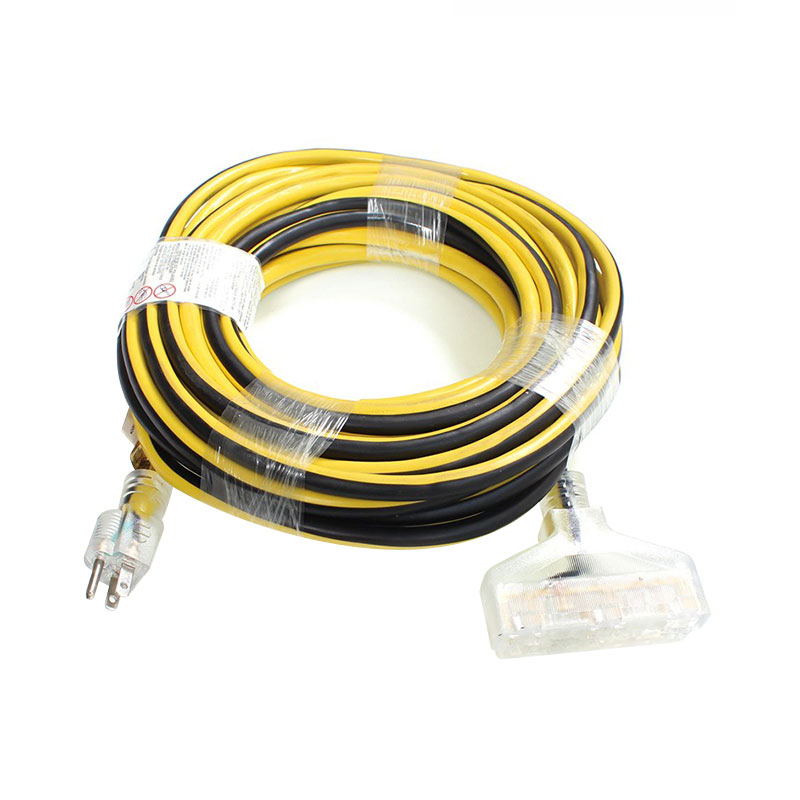
For outdoor and wet work, the specification that holds up is a heavy-duty cord with a grounded plug, a W-rated jacket, and enough gauge to carry the load over the full run length. A cord built for outdoor temporary power typically combines all three: molded strain relief at both ends to survive being dragged, a bright jacket for visibility, and a grounded three-wire configuration so the equipment grounding path is continuous.
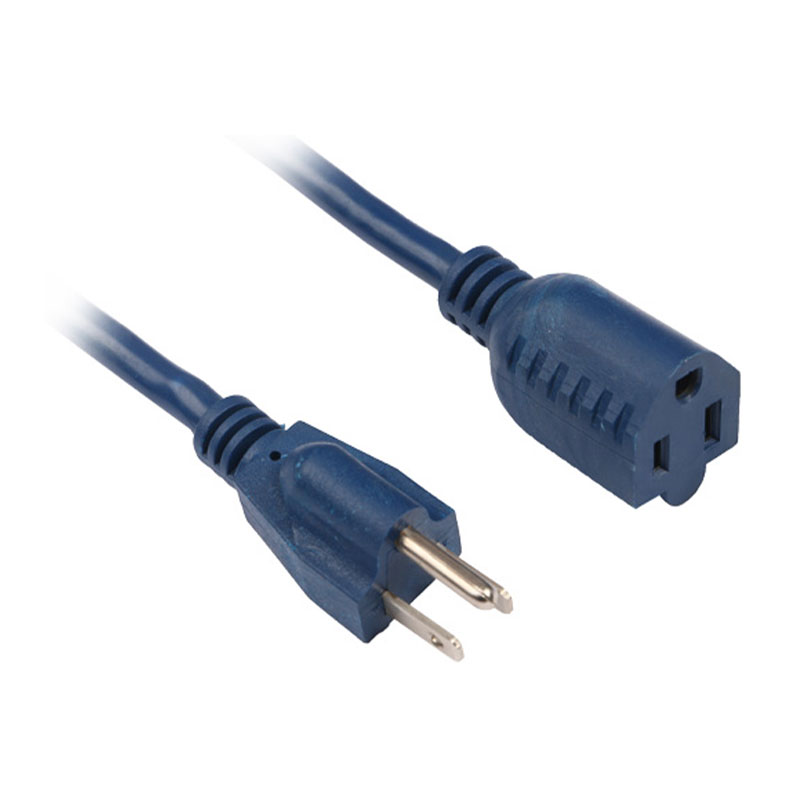 FP-672 Orange Outdoor Extension Cord with Grounded PlugA bright orange PVC outdoor extension cord with grounded three-prong connections; its visibility and weather-resistant jacket suit sheltered outdoor or indoor power runs.View Product →
Visibility deserves a mention because it is a compliance issue disguised as a convenience feature. A cord that blends into the floor gets walked on, driven over, and buried under materials. Bright orange or yellow jackets are not a marketing gimmick; they are a control that reduces mechanical damage and the resulting citations.
Power Strips and Daisy Chains: The Most Common Misunderstanding
Ask ten supervisors whether a power strip counts as an extension cord and you will get ten answers, most of them wrong in a way that costs money.
OSHA's position, developed through letters of interpretation, is that relocatable power taps are not extension cords and must be plugged directly into a permanently installed branch-circuit receptacle. They may not be plugged into an extension cord, and they may not be daisy chained to one another. The reason is mechanical and thermal: the plug-to-receptacle interface is the weakest point in any cord assembly, and each additional connection adds resistance, heat, and a point where a partially inserted plug can arc. A power strip at the end of a 50-foot cord has two extra interfaces and no additional protection.
A surge protector does not change this. A surge-protective power strip is still a relocatable power tap. Its surge rating protects equipment against a transient event; it does nothing about the ampacity of the cord feeding it or the integrity of the plug connection. The same logic applies to outlet multipliers, cube adapters, and three-way taps, all of which convert a compliant single connection into an assembly that no listing covers as a system.
Daisy chaining cords is treated similarly. There is no single sentence in the standard that reads "thou shalt not chain extension cords," but the practice is citable under the general requirement that equipment be free from recognized hazards, and it is a favorite of inspectors because it is instantly visible. Every connection in the chain adds resistance, and resistance under load produces heat at exactly the point where the plug blades have the least contact area.
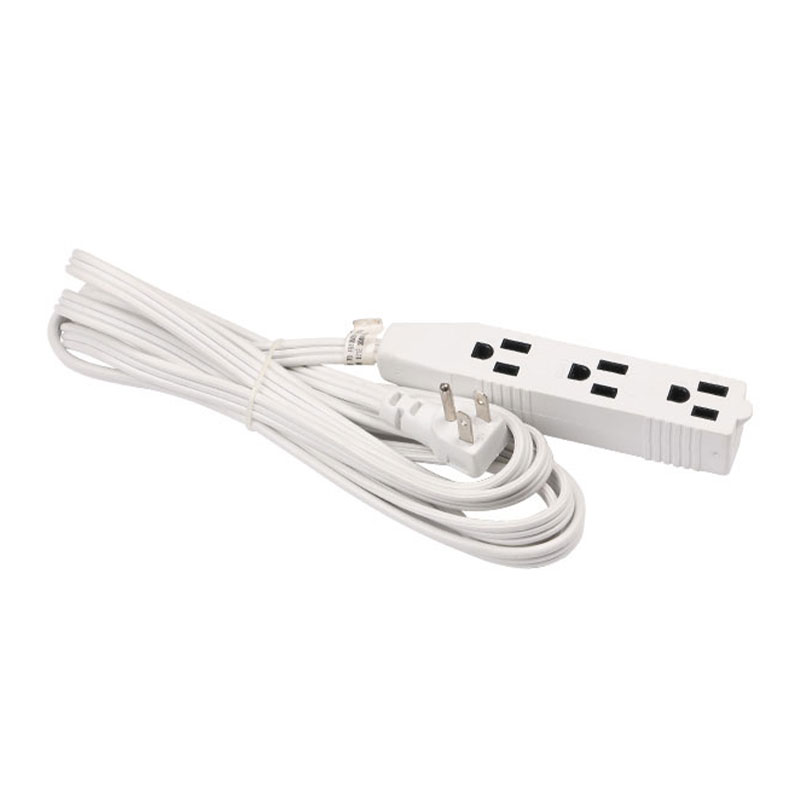
Indoor general-purpose cords are where this rule gets tested most often, because the temptation to reach one more bench is constant. The compliant answer is a single cord of adequate gauge and adequate length, plugged directly into a wall receptacle, with equipment plugged directly into the cord. Where a facility genuinely needs multiple outlets at a workbench, the correct answer is permanently installed receptacles or a fixed raceway — not a cord feeding a strip. A multi-outlet cord set built as a single listed assembly, with molded connections and a grounded plug, is a different product from a cord plus a loose power strip, and inspectors read the difference correctly.
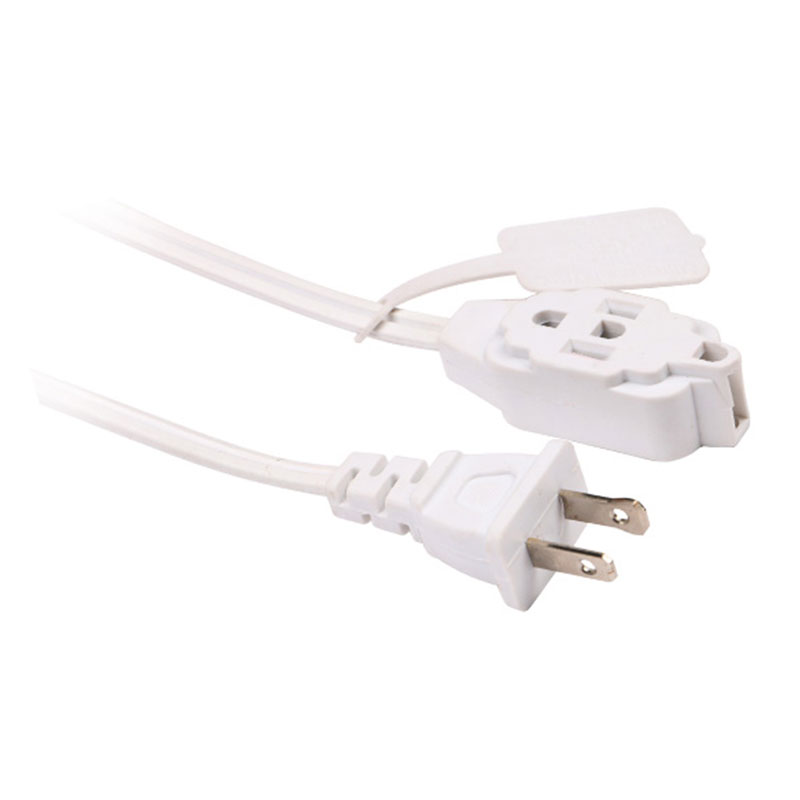
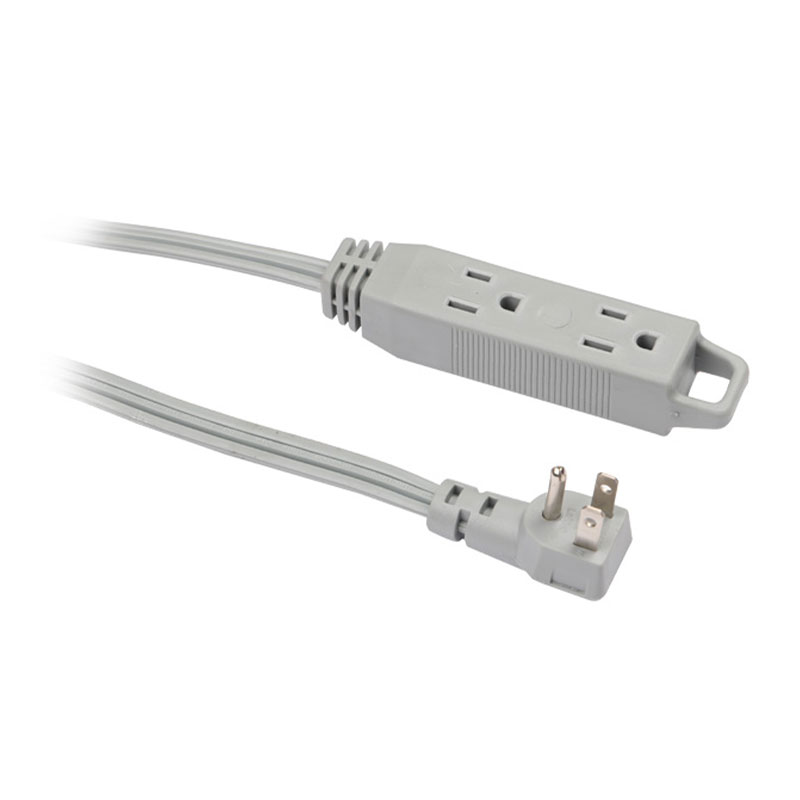 FP-694 and FP-698 Household Multi-Outlet Extension CordsHousehold multi-outlet cords with two-prong US plugs and multiple ports; useful for powering several small devices from one socket in home or office setups.View Product →
One practical note for anyone specifying these assemblies: the number of outlets is not the risk factor. The risk factor is whether each outlet is part of a factory-molded assembly with a known total ampacity, or an add-on device hanging off a cord. The first is a listed product. The second is a hazard waiting for the wrong load.
Strain Relief, Plugs, Adapters, and Physical Protection
Strain relief is one of the least glamorous requirements in the standard and one of the most frequently violated. The rule states that flexible cords must be connected to devices and fittings so that strain relief is provided to prevent pull from being transmitted directly to joints or terminal screws. The failure mode is simple: the cord gets yanked, the conductors pull against the terminals, strands break, resistance rises, and the plug body gets hot. Eventually the connection fails — sometimes as an open circuit, sometimes as a fault.
What good strain relief looks like in practice is a molded plug body or a properly installed replacement cap with a cord grip that clamps the jacket, not the conductors. It also means the cord is not used as a handle to drag equipment across a floor, and it is not hung from a hook by the cord just behind the plug. Two violations, one habit.
Adapters and the grounding question
Three-to-two prong adapters are among the most common finds on older sites. They defeat the equipment grounding conductor, converting a grounded tool into an ungrounded one. If the tool faults, the current has no low-resistance path back to the source and instead finds a path through the operator. Any adapter that lifts the ground is a violation, and so is any adapter that is not part of the listed assembly.
Grounding continuity is easy to verify and rarely verified. A simple continuity tester between the ground pin and the tool's exposed metal frame will confirm the path in seconds. If the meter shows an open, the cord or the tool is defective, and the cord must come out of service until the fault is found. Doing this check on incoming cordsets, and again after any repair, catches the failure mode that inspection by eye cannot see.
Physical protection
The standard requires that flexible cords be protected from accidental damage, and that sharp corners and projections be avoided. Where a cord passes through a doorway or another pinch point, protection must be provided. In practice, that means cable protectors rated for the traffic they will see, cord hangers that support the cord without pinching the jacket, and routing that keeps cords off walking surfaces entirely where possible.
Two things that do not count as protection: duct tape, and running the cord along the hinge side of a door. Tape transfers adhesive to the jacket, hides damage, and provides no resistance to a pallet jack. The hinge side of a door is where the pinch point is worst. The correct solutions — overhead spans, wall-mounted hooks, or a proper floor protector — cost more up front and far less than the citation.
Penalties, Training, and the Paperwork That Decides Outcomes
Cord violations are rarely written as standalone, record-setting penalties. They are typically cited as serious violations, sometimes as other-than-serious, and occasionally as willful or repeat where the same condition has been cited before and nothing changed. Serious violations carry a maximum penalty that is adjusted for inflation each January and now sits in the low-to-mid five figures per violation. Willful and repeat violations reach into six figures. Failure to abate carries a per-day maximum that accrues until the condition is corrected.
The math that matters is not the per-violation number; it is the multiplier. A single walkthrough of an active site commonly generates a dozen cord-related findings — damaged cords, missing strain relief, GFCI gaps, cords through doorways, daisy chains. Each is separately citable. Multiply one finding by twelve, add the abatement period, and the cost of a five-dollar cord becomes an irrelevant rounding error.
Repeat citations are the bigger strategic risk. Once an employer has been cited for a specific condition, a second citation for a substantially similar condition at any of that employer's sites within the repeat window can be classified as repeat, which changes both the penalty and the burden of proof. A cord program that is not actually executed therefore costs more the second time it fails than the first.
Training under 1910.332
Employees who face a risk of electric shock that is not reduced to a safe level by the installation requirements must be trained. The training must cover safe work practices, the relationship between electrical hazards and the specific equipment the employee uses, and the procedures for working on or near exposed energized parts. It must be provided before the employee is exposed to the hazard, and it must be repeated when the employee's responsibilities change or when inspections show that the employee is not retaining the required knowledge.
For cords, this translates into training that is specific rather than generic. Telling a crew "be careful with electricity" satisfies nothing. What satisfies the requirement is showing them, on the actual equipment they use, what a damaged jacket looks like, why a taped splice is not a repair, why a three-to-two adapter defeats the ground, and what the inspection before each shift actually consists of. Retraining is documented when a supervisor observes a violation — not because the employee is being punished, but because the observation is evidence that the required knowledge was not retained.
Records that survive scrutiny
- A written AEGCP description, if you use that alternative to GFCIs, including the intervals and the testing method.
- Continuity test records for cord sets and receptacles, dated and signed by the competent person who performed them.
- GFCI test logs, showing monthly testing with a note of any device that tripped or failed.
- Documented training rosters keyed to the specific hazards of the equipment in use.
- A written cord specification that states gauge, jacket type, length limits, and approved configurations for each work area.
None of this is burdensome if it is built into the daily routine. All of it is impossible to reconstruct after an incident.
Sourcing Compliant Cords: A Buyer's Checklist
Most of the cord violations on a given site trace back to a purchasing decision made months earlier. Someone bought a case of the cheapest 16-gauge cord available, in a length that was convenient rather than appropriate, with no weather rating, and now the crew is using it outdoors on a 13-amp load in the rain. The compliance problem was created at the purchase order.
If you buy cords in volume — for a contractor fleet, a rental yard, a maintenance operation, or a retail program — the specification is where safety and liability are decided. The checklist that matters looks like this.
Match the cord to the load, not to the price
Determine the highest-current tool that will run on the cord, add margin, and choose the gauge accordingly. A 15-amp tool on a 100-foot run wants 12-gauge, not 16. Then decide the length: long cords on light loads are usually fine, long cords on heavy loads are not. A cord inventory with three lengths and two gauges covers nearly every task on a normal site and removes the incentive to chain two cords together.
Match the jacket to the environment
Indoor dry work in a climate-controlled shop can use a standard SJT cord. Outdoor work needs W or W-A. Cold environments favor elastomer jackets. Oil and chemical exposure calls for O or OO. Food-processing and washdown areas need cords rated for wet locations and connectors that resist moisture ingress. Buying a single general-purpose cord for all of these environments guarantees that most of them will be used outside their rating.
Match the plug to the market
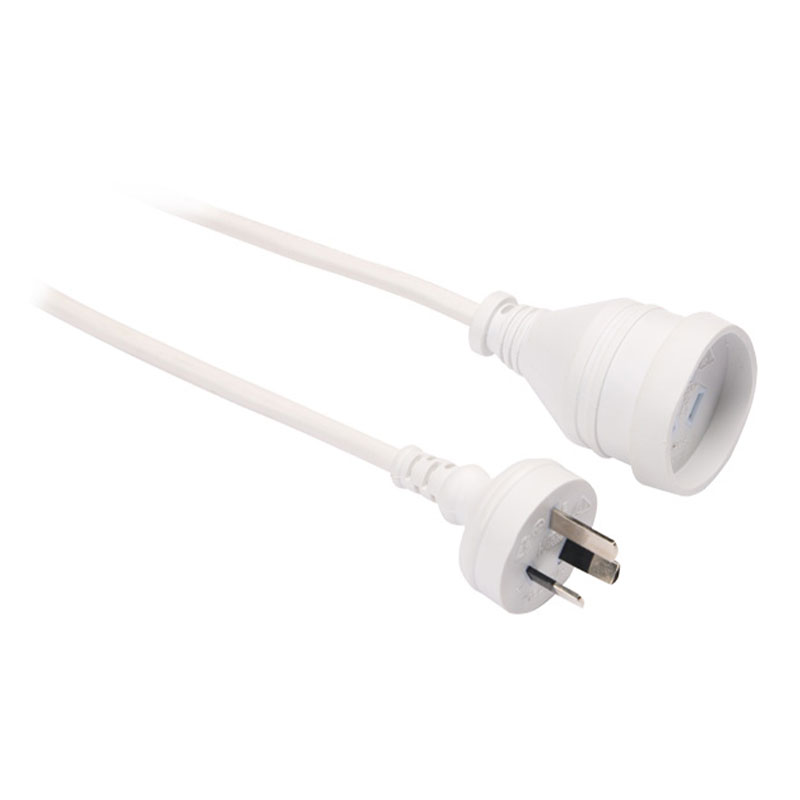
This is where exporters and multinational operators get caught. North American sites need NEMA configurations, Europe needs the appropriate two-pin or Schuko configuration, the United Kingdom needs the fused three-pin pattern, and Australia, South Africa, and Brazil each have their own. A cord supplied with the wrong plug pattern for the destination market gets adapted in the field, and field adaptations are where grounding gets defeated. Sourcing cords already built to the destination standard removes the adapter from the equation.
It is also worth reading the applications side of that question. Different appliances place different demands on a cord — continuous current draw, heat exposure, flexing, moisture — and a cord that is compliant for a portable lamp may be the wrong product for a 2,000-watt space heater. Our overview of extension cords for various electrical appliances breaks the requirements down by equipment type, which is a useful cross-check before a purchase order goes out.
Match the assembly to the application, and get the listing right
Where a facility needs multiple outlets, buy a listed multi-outlet cord assembly rather than a cord plus a loose power strip. Where a workstation needs a permanently available outlet, install a receptacle or a raceway. Where the cord will be dragged and coiled daily, specify molded strain relief and a jacket that resists abrasion rather than the lightest available option. For industrial equipment and machinery, the selection criteria go beyond gauge — connector type, temperature rating, and cable construction all matter, and the same logic applies to our power cord selection guidance for industrial equipment.
European and other export markets often need a cord that is both heavy duty and highly visible, because the working environment mixes pedestrian traffic with powered equipment. A heavy-duty assembly with a high-visibility jacket, molded connectors, and a grounded plug covers the majority of those requirements in one part number, which simplifies both the compliance story and the inventory.
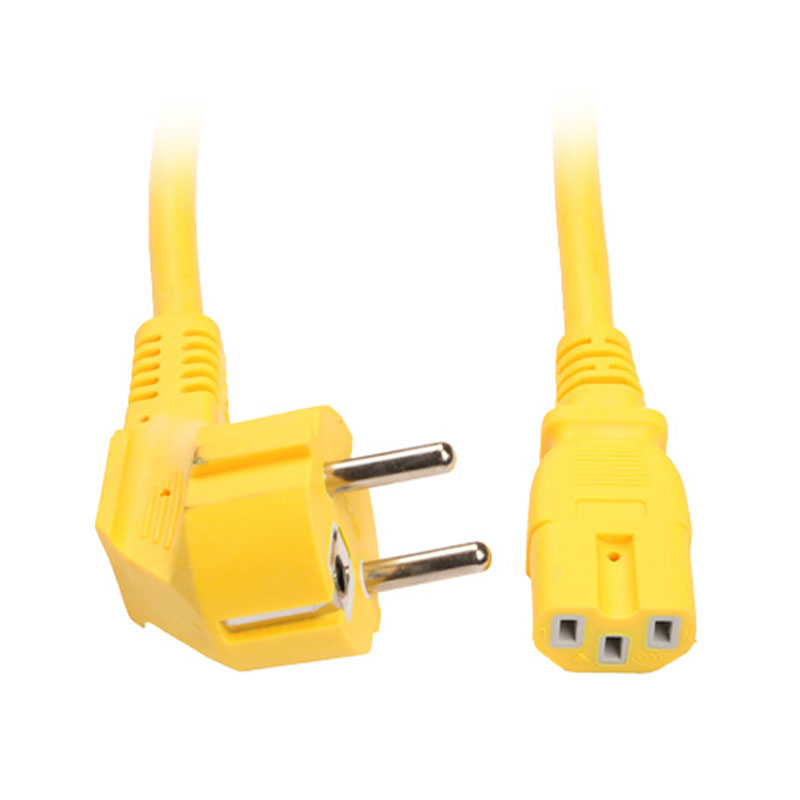 FP-726, FP-706 and FP-710 European Plug Extension CordsHeavy-duty European-plug extension cords with high-visibility design; suited to extending power reach in homes, offices, or industrial settings where durable cordage is useful.View Product →
Demand the documentation
For any cord purchased in volume, ask for the listing file and the ratings that apply to the specific part number, not the product family. Confirm the conductor gauge, the jacket code, the temperature rating, the voltage and amperage ratings, and the plug configuration in writing. If the supplier cannot state the jacket code for a specific SKU, that SKU is not specifiable for outdoor or wet use — and if it ends up in the rain anyway, the paper trail will not protect you.
A manufacturer with a real production line and an in-house laboratory can typically answer these questions in a single email and, in many cases, build the cord to the destination market's standard rather than shipping a general-purpose product that the buyer then has to adapt. That capability matters more for cords than for almost any other electrical accessory, because the compliance failures are almost always configuration failures rather than manufacturing defects.
Building a Cord Program That Survives a Walkthrough
Everything above collapses into a short list of operational habits. Written specifications that state gauge, jacket type, and length for each work area. A purchasing rule that forbids buying anything outside those specifications, including the "just this once" case. A daily inspection that takes thirty seconds and is actually performed. Destruction of damaged cords, not tagging and storage. GFCI protection installed and tested on every temporary receptacle, with the tests logged. Training that shows people the specific failure modes on the specific equipment they use. And a documented review after every incident or near miss that asks whether the cord was the right product for the job, not just whether it was undamaged.
None of these steps is expensive. Together they address the three questions an inspector asks — suitability, condition, and use — which means the walkthrough that produces twelve findings in a poorly managed site produces none in a well-managed one. The cords cost the same. The difference is entirely in the decisions made before the cord was ever plugged in.
Latest Updates
Provide You With The Latest Enterprise
Provide You With The Latest Enterprise
and Industry News.
We will continue to focus on the intelligent temperature control field and serve global users with technical concepts of "safer, more energy-efficient and more environmentally friendly".
-
Industry News
The Ultimate Guide to Immersion Water Heaters: From Portable Heating to Safety Best Practices
11
Feb 2026
Be the First to Know
For exclusive deals and latest offers, sign up by entering your email address below.
-

Provide one-stop service from design optimization, process improvement to volume delivery.
-
Quick Links
Home Products About Us Advantages Application News Contact Us -
Products Categories
Immersion Water Heater Extension Cord Power Strip Power Cord Heating Element Hot Plate Magnesium Anode Rod Electrical Water Heater Stem Thermostat -
Contact Information
Add : Feida Industrial Park , Houxiang Town, Danyang City , Jiangsu Province ,China
E-mail: gm@cnfpdq.com
Tel: +86-13306103666
Fax: +86-511-86321126
Copyright © 2025 by Danyang Feipeng Electrical Appliance Co., Ltd. All Rights Reserved.
 Custom Electric Heater Components Manufacturers
Custom Electric Heater Components Manufacturers