

 English
 русский
 Español
 عربى
عربى
A Complete Practical Guide to Choosing the Right Extension Cord, Outdoor Extension Cord, 8 Gauge, 10 Gauge, 12 Gauge, and 14 Gauge Extension Cord for Every Job
The direct answer to what gauge extension cord you need is this: choose the gauge based on two factors, the wattage or amperage of the device you are powering and the length of the cord you need. As a practical rule: use a 14 gauge extension cord for light-duty devices up to 1,400 watts on runs under 25 feet; use a 12 gauge extension cord for most household tools and appliances up to 1,875 watts on runs up to 50 feet; use a 10 gauge extension cord for high-draw tools and equipment up to 2,500 watts on runs up to 100 feet; and use an 8 gauge extension cord for the heaviest equipment, large compressors, and RV connections drawing up to 40 to 50 amps on longer runs. For any outdoor use, always select a rated outdoor extension cord regardless of gauge, as outdoor-rated cords are built with insulation that resists moisture, UV degradation, and temperature extremes that destroy standard indoor cords. Using a cord that is too light for the connected load is a leading cause of electrical fires and damaged equipment.
Understanding Wire Gauge: Why a Lower Number Means a Heavier and More Capable Cord
Wire gauge in the United States is measured using the American Wire Gauge (AWG) system. The counterintuitive truth about this system is that a lower gauge number always means a thicker wire with greater current carrying capacity. An 8 gauge wire is physically larger in diameter than a 10 gauge wire, which is larger than a 12 gauge wire, which is larger than a 14 gauge wire. This matters enormously for extension cords because a wire that is too thin for the current being drawn through it will overheat. Heat buildup in an undersized extension cord can melt insulation, start fires inside walls or behind furniture, and permanently damage connected appliances and tools by delivering reduced voltage.
The relationship between gauge, wire diameter, and resistance is fundamental. A thicker wire has lower electrical resistance per foot. Lower resistance means less voltage drop along the cord and less heat generated for a given current. When you extend the length of a cord, you increase the total resistance of the wire path, which increases voltage drop. This is why a 12 gauge cord rated for 50 feet may not be adequate at 100 feet for the same tool: the longer run increases resistance and the resulting voltage drop may starve the motor of voltage, causing it to overheat and fail even though the cord itself feels only warm.
How to Calculate What You Need: Amps, Watts, and Cord Length
To determine what gauge extension cord you need, you must know two things: the amperage draw of your device and the length of cord you need. Amperage is printed on the nameplate of most appliances and tools. If only wattage is listed, divide the wattage by the voltage (120 volts in most US households) to get amps. For example, a 1,440 watt electric leaf blower draws 12 amps (1,440 divided by 120). A 1,800 watt electric heater draws 15 amps. A 2,400 watt compressor motor draws 20 amps.
Once you have the amp draw and the cord length you need, the selection table below gives you the correct gauge. Always round up to the next heavier gauge when your combination of amps and length falls near a boundary, because the cost of a heavier gauge cord is far less than the cost of repairing or replacing damaged equipment or dealing with a fire.
| Amperage Draw | Up to 25 Feet | Up to 50 Feet | Up to 100 Feet | Up to 150 Feet |
|---|---|---|---|---|
| 1 to 5 Amps | 16 AWG | 16 AWG | 14 AWG | 14 AWG |
| 6 to 10 Amps | 16 AWG | 14 AWG | 12 AWG | 12 AWG |
| 11 to 15 Amps | 14 AWG | 12 AWG | 10 AWG | 10 AWG |
| 16 to 20 Amps | 12 AWG | 10 AWG | 10 AWG | 8 AWG |
| 21 to 30 Amps | 10 AWG | 10 AWG | 8 AWG | 8 AWG |
| 31 to 50 Amps | 8 AWG | 8 AWG | 6 AWG | 6 AWG |
The Physical Dimensions and Ampacity of Each Gauge
For reference, here are the physical dimensions and maximum safe ampacity for the four most common extension cord gauges:
- 8 AWG: Wire diameter approximately 0.128 inches (3.26 mm). Maximum ampacity in an extension cord context: 40 to 50 amps. Resistance approximately 0.000628 ohms per foot per conductor.
- 10 AWG: Wire diameter approximately 0.102 inches (2.59 mm). Maximum ampacity: 30 amps. Resistance approximately 0.000999 ohms per foot per conductor.
- 12 AWG: Wire diameter approximately 0.081 inches (2.05 mm). Maximum ampacity: 20 amps. Resistance approximately 0.001588 ohms per foot per conductor.
- 14 AWG: Wire diameter approximately 0.064 inches (1.63 mm). Maximum ampacity: 15 amps. Resistance approximately 0.002525 ohms per foot per conductor.
14 Gauge Extension Cord: Light Duty Household and Office Use
A 14 gauge extension cord is the lightest gauge that electrical safety experts recommend for general household use. It is rated for a maximum of 15 amps and 1,875 watts at 120 volts, which covers most household lamps, televisions, laptop chargers, fans, small radios, phone chargers, electric blankets, and similar low to moderate draw devices. The 14 gauge cord is the most physically flexible and lightest weight of the commonly available gauges, making it easy to route around furniture and through doorways.
The practical limitation of the 14 gauge extension cord is its sensitivity to length. At 25 feet, a 14 gauge cord works well for its rated amperage range. At 50 feet, voltage drop becomes significant for loads above about 10 amps. At 100 feet, a 14 gauge cord should not be used for anything above about 5 amps. This is why many 14 gauge cords sold commercially are limited to 25 or 35 foot lengths; manufacturers recognize that longer versions of this gauge create a voltage drop risk that consumers may not be aware of.
What a 14 Gauge Extension Cord Is and Is Not Suitable For
Suitable applications for a 14 gauge extension cord include:
- Table lamps, floor lamps, and decorative string lights drawing up to 300 watts
- Televisions, computer monitors, desktop computers, and audio equipment
- Small kitchen appliances including coffee makers (below 1,200 watts), toasters (below 900 watts), and blenders in short burst use
- Box fans and ceiling fan remote receivers drawing under 200 watts
- Phone chargers, tablet chargers, and laptop power adapters
- Holiday lighting and decorative outdoor lights on short runs (25 feet or less)
A 14 gauge extension cord is not suitable for space heaters (which draw 1,500 watts or 12.5 amps continuously), air conditioners, circular saws, angle grinders, air compressors, power washers, or any motor-driven tool. These devices should use at minimum a 12 gauge cord for short runs and a heavier gauge for longer runs.
12 Gauge Extension Cord: The Best All-Around Choice for Tools and Appliances
A 12 gauge extension cord is the recommended gauge for the majority of household and workshop applications. It is rated for a maximum of 20 amps and 2,400 watts at 120 volts, which covers virtually all standard 120 volt household outlets (which are wired with 15 or 20 amp circuit breakers). This means a 12 gauge extension cord can safely carry any load that a standard household outlet can supply without becoming a voltage drop or overheating risk.
The 12 gauge extension cord is the workhorse of the home workshop and the job site for 120 volt tools. Its combination of adequate ampacity for serious power tools and manageable physical weight and flexibility makes it the default recommendation from electricians and tool manufacturers for use with drills, circular saws, jigsaws, belt sanders, shop vacuums, and similar equipment. When in doubt about what gauge to buy for general home and workshop use, a 12 gauge extension cord rated for outdoor use is the safest and most versatile choice.
Common Applications for a 12 Gauge Extension Cord
- Electric drills and drill drivers: Most corded drills draw 5 to 8 amps. A 12 gauge cord handles these comfortably at runs up to 100 feet.
- Circular saws: 7 1/4 inch circular saws typically draw 10 to 15 amps. A 12 gauge cord is adequate for runs up to 50 feet; use a 10 gauge for longer runs.
- Shop vacuums: Most shop vacs draw 8 to 12 amps. A 12 gauge cord is suitable for runs up to 50 to 75 feet.
- Electric mowers and string trimmers: Corded electric mowers draw 10 to 13 amps. A 12 gauge outdoor extension cord is the minimum recommended gauge for these tools.
- Space heaters: A 1,500 watt space heater draws 12.5 amps continuously. A 12 gauge cord rated for continuous use is the minimum safe gauge; extension cord use with space heaters is still discouraged by manufacturers for permanent placement.
- Window air conditioners: Small window ACs drawing up to 15 amps can use a 12 gauge cord for short temporary runs, though direct outlet connection is always preferred.
- Electric leaf blowers and hedge trimmers: Most draw 8 to 14 amps. A 12 gauge outdoor extension cord is appropriate for runs up to 75 feet.
Why the 12 Gauge Extension Cord Is the Recommended Default Choice
Electricians and tool manufacturers consistently recommend the 12 gauge extension cord as the default choice when users are uncertain because it covers the full range of 15 amp circuit breaker loads (which is the most common residential circuit in North America) at reasonable cord lengths, while costing only modestly more than a 14 gauge cord of equivalent length. The price difference between a quality 25 foot 14 gauge cord and a 25 foot 12 gauge cord is typically $3 to $8 at retail, a trivial additional cost for significantly improved safety margin and versatility. The 12 gauge cord also handles the starting surge current of motor-driven tools better than a 14 gauge cord, because electric motors can draw 3 to 6 times their running amperage for the fraction of a second it takes them to reach operating speed.
10 Gauge Extension Cord: Heavy Duty Tools and Long Runs
A 10 gauge extension cord is the correct choice for the heaviest 120 volt equipment, for runs longer than 50 feet with high-draw tools, or for any situation where the total load approaches or meets the 20 amp maximum of a standard heavy-duty circuit. Rated for up to 30 amps on a 120 volt circuit, the 10 gauge extension cord provides substantial headroom above the typical 15 and 20 amp household circuit ratings, ensuring that even sustained heavy tool use does not create heat buildup in the cord.
The 10 gauge cord is noticeably heavier and stiffer than 12 or 14 gauge cords of the same length. A 100 foot 10 gauge extension cord typically weighs 8 to 12 pounds, compared to 5 to 7 pounds for a 100 foot 12 gauge cord. This weight and stiffness is a physical consequence of the larger wire cross-section and is the price paid for the cord's superior current carrying capability. For job sites and workshops where the cord is laid out at the start of a shift and coiled at the end, this weight is a minor inconvenience. For light frequent movement, a 12 gauge cord may be more practical.
Situations That Require a 10 Gauge Extension Cord
- Table saws and miter saws: These tools draw 13 to 18 amps under load and require a 10 gauge cord for any run exceeding 25 to 30 feet to prevent voltage drop from damaging the motor.
- Air compressors: A 15 to 20 amp air compressor motor benefits greatly from a 10 gauge cord even on short runs, because the motor starting surge on a compressor is among the highest of any common shop tool.
- Electric pressure washers: High-performance electric pressure washers drawing 14 to 20 amps need a 10 gauge cord for runs beyond 25 feet.
- Long runs to outbuildings and work areas: Any run of 75 to 150 feet carrying 15 to 20 amps requires 10 gauge wire to stay within acceptable voltage drop limits.
- Multiple tools on one cord: When you connect a power strip to an extension cord and run two or more tools simultaneously, the combined amperage may exceed 15 amps and require 10 gauge wire for safety.
- Plasma cutters and welders: Smaller plasma cutters and 120 volt MIG welders drawing up to 20 amps require 10 gauge extension cords to prevent voltage drop that degrades cut or weld quality.
The Voltage Drop Problem: Why Length Matters So Much at High Loads
To illustrate why gauge matters so much at longer runs, consider a circular saw drawing 15 amps connected to a 100 foot extension cord. With a 14 gauge cord (resistance approximately 0.00253 ohms per foot per conductor), the total round-trip resistance of 100 feet of cord is approximately 0.506 ohms. At 15 amps, this creates a voltage drop of 7.6 volts, reducing the 120 volt supply to approximately 112.4 volts at the tool. That is a voltage reduction of over 6%, which causes the saw motor to draw more current attempting to maintain power, generating heat that shortens motor life and can trip the circuit breaker.
With a 10 gauge cord (resistance approximately 0.001 ohm per foot per conductor), the same 100 foot run at 15 amps produces a voltage drop of only 3.0 volts, keeping the tool voltage at approximately 117 volts, well within acceptable limits. This difference in cord resistance is the physical reason why upgrading to a heavier gauge cord for longer runs and higher loads is not optional but essential for protecting both the cord and the connected equipment.
8 Gauge Extension Cord: RV Shore Power, Large Equipment, and Very Long Runs
An 8 gauge extension cord is the heaviest gauge available as a general-purpose extension cord in most consumer and commercial markets. Rated for 40 to 50 amps in extension cord configurations, the 8 gauge cord is required for the highest-draw residential and light commercial applications. It is physically substantial: a 25 foot 8 gauge extension cord typically weighs 5 to 8 pounds and is stiff enough that coiling and uncoiling requires deliberate effort. The payoff is the ability to deliver full power to the most demanding equipment without voltage drop or thermal stress on the cord.
The most common applications requiring an 8 gauge extension cord are RV shore power connections, large window or portable air conditioners on long runs, large electric dryers or ranges that may be temporarily disconnected from a fixed outlet, generator connections, and industrial power tools requiring sustained 30 to 40 amp supply. In the RV market, 30 amp and 50 amp shore power cords are almost universally 8 gauge or heavier, and RV manufacturers specifically prohibit the use of lighter gauge cords because the sustained air conditioning, refrigeration, and water heater loads in a fully loaded RV can easily consume 25 to 45 amps continuously.
Specific Applications for an 8 Gauge Extension Cord
- RV and camper shore power: A 30 amp RV requires an 8 gauge cord for its TT-30 shore power connection. A 50 amp RV requires an even heavier 6 gauge cord. Never use a standard 12 or 14 gauge household extension cord as an RV shore power adapter.
- Large portable generators: When connecting a generator to a transfer panel or to multiple appliances through a heavy-duty power block, an 8 gauge cord handles the sustained multi-appliance load safely.
- Large air conditioners: Window units of 18,000 BTU and above can draw 20 amps or more. When temporary extension cord use is unavoidable, an 8 gauge cord on a short run is the safe choice.
- Large compressors for spray painting and pneumatic tools: Industrial-scale compressors drawing 25 to 30 amps on startup require 8 gauge extension cords for any run beyond 25 feet.
- Very long runs at 20 amp loads: For runs of 150 feet or more carrying 20 amp loads, an 8 gauge cord keeps voltage drop within acceptable limits where a 10 gauge cord would exceed safe drop thresholds.
240 Volt Considerations for 8 Gauge Extension Cords
Some 8 gauge extension cords are configured for 240 volt service rather than 120 volt service, particularly for RV and generator use. A 240 volt 8 gauge cord uses a different plug and receptacle configuration (NEMA 14-30 or NEMA 6-30 for example) compared to the standard 120 volt NEMA 5-15 or 5-20 configurations. When purchasing an 8 gauge extension cord, confirm both the voltage rating and the plug configuration match your specific application. Never attempt to adapt a 240 volt cord to a 120 volt outlet or vice versa, as the voltage mismatch will immediately damage connected equipment or create a shock and fire hazard.
Outdoor Extension Cord: Why Indoor Cords Must Never Be Used Outside
The distinction between an indoor extension cord and an outdoor extension cord is not primarily about gauge or ampacity. It is about the outer jacket material and construction. An outdoor extension cord is built to survive environmental conditions that rapidly destroy indoor cords: rain and moisture, direct sunlight and UV radiation, temperature extremes from freezing cold to intense summer heat, abrasion from being dragged across concrete or gravel, and in some cases submersion in puddles. Using a standard indoor extension cord outside, even briefly, is a serious electrical safety risk.
How to Identify a Genuine Outdoor Extension Cord
A genuine outdoor extension cord is identified by the following markings and features:
- Letter W in the cord designation: The wire insulation designation printed on the jacket of a cord identifies its suitability. An outdoor-rated cord will have a W in its designation, for example SJTW or SJTOW or STW. The W specifically indicates that the cord is weather-resistant and rated for outdoor use. A cord marked SJT without a W is an indoor-only cord.
- Three-prong grounded plug: Any outdoor extension cord should have a three-prong grounded plug and a three-slot grounded receptacle. The ground conductor is essential for safe operation of power tools outdoors where accidental contact with wet ground creates shock hazard. Never use a two-prong ungrounded cord outdoors with power tools.
- Thicker and more flexible jacket at low temperatures: Quality outdoor extension cords are made with thermoplastic elastomer (TPE) or rubber jacket compounds that remain flexible even at temperatures below 0 degrees Fahrenheit. Indoor cords with PVC jackets become stiff and crack at low temperatures, exposing the insulated conductors to moisture ingress.
- UL, ETL, or CSA listing: Look for the certification mark from a nationally recognized testing laboratory on the cord and packaging. This confirms the cord has been tested to applicable safety standards for its listed applications. A certification label claiming outdoor rating without a third-party listing is not reliable.
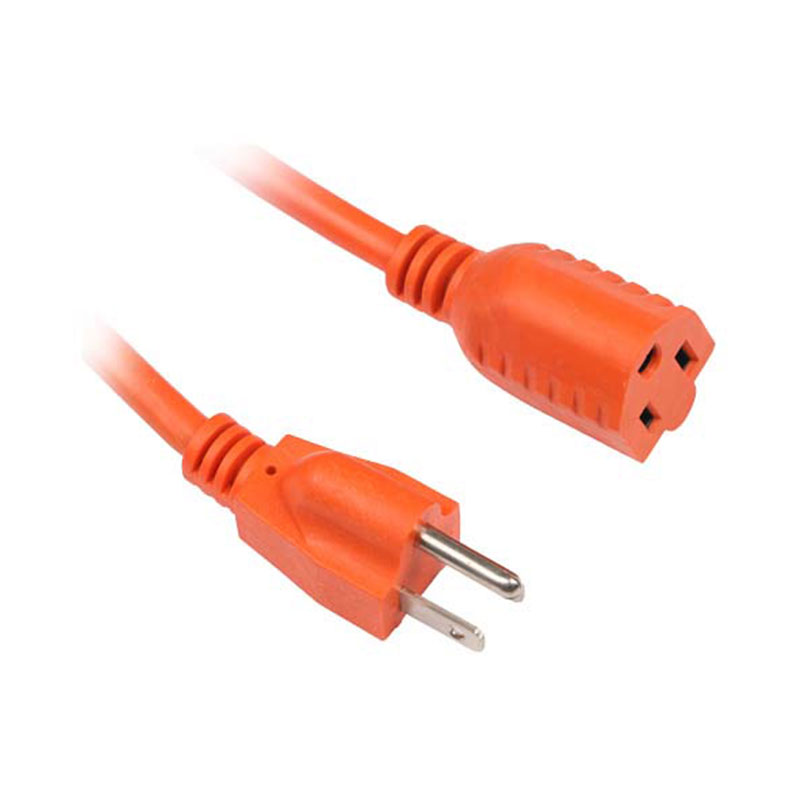
- Orange or yellow jacket color: Most outdoor extension cords are produced in highly visible orange or yellow jacket colors, not because it is required but because visibility on the ground reduces the risk of tripping and accidental cutting. This is a practical feature but not a safety certification in itself.
Outdoor Extension Cord Uses: Yard Work, Construction, and Holiday Lighting
The outdoor extension cord is essential for a wide range of common tasks:
- Corded lawn mowers and electric mowers: Use a 12 gauge outdoor extension cord in the appropriate length for your yard size. 50 foot and 100 foot lengths are common for most residential yards. Confirm the cord length does not exceed the tool manufacturer's maximum recommended extension cord length.
- String trimmers and edgers: Most draw 5 to 8 amps. A 12 gauge outdoor extension cord at 50 to 100 feet works well for these tools.
- Leaf blowers: Electric leaf blowers draw 8 to 15 amps depending on the model. A 12 gauge outdoor extension cord at 50 to 75 feet is appropriate for most models.
- Electric chainsaws: These draw 12 to 15 amps. Use a 12 gauge outdoor extension cord for runs up to 50 feet, and a 10 gauge for longer runs.
- Holiday and outdoor lighting: For permanent outdoor string lights, pathway lights, and seasonal holiday displays, a 14 or 16 gauge outdoor extension cord may be adequate due to the low wattage of LED lighting. However, always use outdoor-rated cords and outdoor-rated connection covers when connections will be exposed to rain.
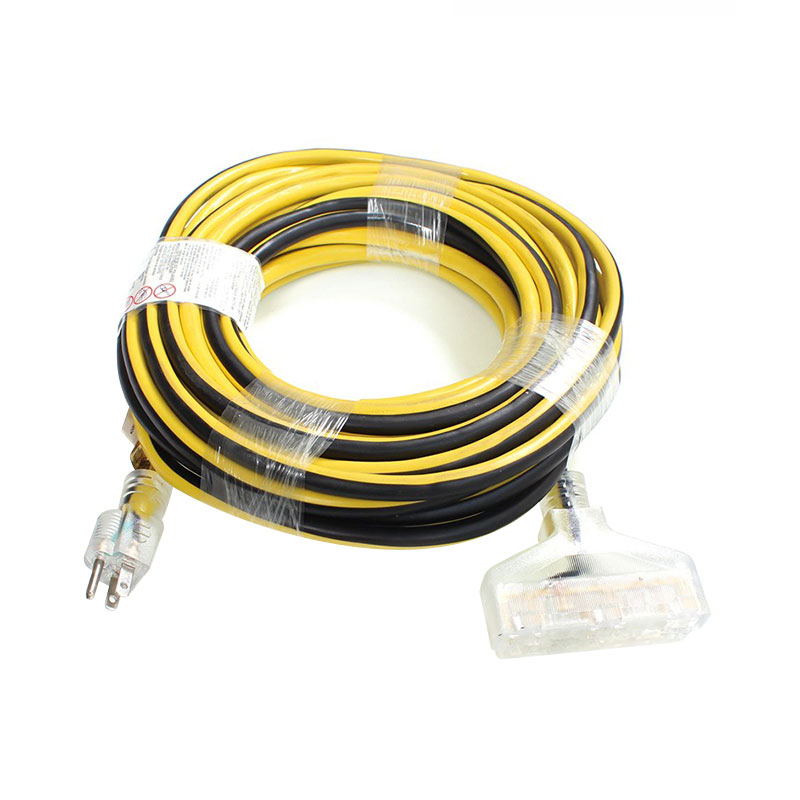
- Construction site power: On construction sites, job-rated outdoor extension cords with heavy-duty lighted ends (which show when the cord is energized), heavy rubber jackets, and contractor-grade strain relief at the connections are standard. These cords are designed to survive daily rolling, dragging, and exposure to construction site conditions.
GFCI Protection for Outdoor Extension Cords: A Critical Safety Requirement
Ground Fault Circuit Interrupter (GFCI) protection is required by the National Electrical Code (NEC) for all outdoor receptacles and for temporary wiring used on construction sites. When using an outdoor extension cord connected to an outdoor GFCI outlet, the GFCI protection at the outlet covers the entire cord and connected equipment. When using an indoor extension cord that happens to reach an outdoor work area (which is unsafe for other reasons), or when the source outlet does not have GFCI protection, a GFCI inline adapter or a GFCI extension cord should be used.
A GFCI device detects a current imbalance of as little as 4 to 6 milliamps between the hot and neutral conductors, which indicates that current is flowing to ground through an unintended path (such as through a person in contact with a faulty tool). The GFCI interrupts the circuit within one-fortieth of a second, fast enough to prevent cardiac fibrillation in most cases. Electrocution from outdoor power tool use in wet conditions is a preventable event; GFCI protection prevents it. Always confirm that your outdoor circuit or cord is GFCI protected before beginning work in wet or damp conditions.
Extension Cord Safety: Rules That Prevent Fires and Equipment Damage
Extension cords are one of the most misused electrical products in the average home and workplace. The U.S. Consumer Product Safety Commission estimates that extension cords cause approximately 4,700 residential fires each year, resulting in around 50 deaths, 270 injuries, and $156 million in property damage. The overwhelming majority of these incidents are preventable through correct gauge selection and safe use practices.
The Most Important Extension Cord Safety Rules
- Never daisy-chain extension cords: Connecting two or more extension cords end-to-end increases the total resistance of the circuit and the total length, compounding voltage drop problems. It also creates additional connection points where heat can build up if the connection is not making full contact. If you need a longer cord, buy one long enough for your needs.
- Never run extension cords under rugs or carpets: The rug insulates the cord and prevents heat from dissipating. Heat that would be harmless in open air can build up under a rug to ignition temperatures. Extension cords run under rugs also suffer undetected mechanical damage from foot traffic that can abrade through the insulation and create a shock or fire risk.
- Never use an extension cord as permanent wiring: Extension cords are designed for temporary use only. If you consistently need a cord in a fixed location, have a licensed electrician install a permanent outlet at that location.
- Always unroll the cord fully before use: A coiled extension cord carrying high current generates heat that cannot dissipate through the coil the way it would from a straight run. A tightly coiled 12 gauge cord at 15 amps can reach temperatures that damage the insulation even though the same cord in a straight run would remain cool to the touch.
- Check cords regularly for damage: Inspect the full length of every extension cord before each use. A cord with cracked, frayed, or cut insulation must be replaced, not repaired with electrical tape. Tape repairs create a false sense of security while leaving an unsafe conductor exposed.
- Never use an indoor cord outdoors: As covered in the outdoor extension cord section, indoor cord insulation degrades rapidly in outdoor conditions, creating both shock and fire hazards.
- Do not plug power strips into extension cords: Power strips are designed to be plugged directly into a wall outlet, not into an extension cord. The combination of the extension cord resistance and multiple high-draw devices on the strip often exceeds safe operating parameters for both the cord and the strip.
- Match the plug prongs to the outlet: Never remove the ground prong from a three-prong plug to fit a two-prong outlet. The ground conductor protects against electrical shock from equipment faults. If your outlet does not have a ground, have an electrician install a properly grounded outlet.
Extension Cord Comparison: All Four Gauges at a Glance
| Feature | 8 Gauge | 10 Gauge | 12 Gauge | 14 Gauge |
|---|---|---|---|---|
| Max amps | 40 to 50 A | 30 A | 20 A | 15 A |
| Max watts (120V) | 4,800 to 6,000 W | 3,600 W | 2,400 W | 1,875 W |
| Best run length | Up to 150 ft | Up to 100 ft | Up to 50 ft | Up to 25 ft |
| Physical weight | Very heavy | Heavy | Medium | Light |
| Flexibility | Stiff | Moderately stiff | Flexible | Very flexible |
| Relative cost | Highest | High | Moderate | Lowest |
| Typical primary uses | RV, generator, large AC | Table saw, compressor, long runs | Power tools, mowers, general workshop | Lamps, electronics, small appliances |
Frequently Asked Questions About Extension Cord Gauge
1. What gauge extension cord do I need for a space heater?
A standard 1,500 watt space heater draws 12.5 amps continuously, which is one of the most demanding continuous loads a consumer appliance places on an extension cord. Use a 12 gauge extension cord for the shortest possible run, and only as a temporary measure. Most space heater manufacturers explicitly warn against using extension cords at all, and virtually all fire marshals advise against it. If you must use a cord, it should be a 12 gauge cord of the shortest length possible, plugged directly into a wall outlet with no other devices on the same circuit, and never left unattended or used with the cord coiled or under furniture.
2. Can I use a 14 gauge extension cord for a circular saw?
For very short runs of under 10 to 15 feet, a 14 gauge cord may not cause immediate damage to a small circular saw, but it is not recommended. A full-size 7.25 inch circular saw draws 13 to 15 amps under load, and the starting surge can reach 3 to 5 times the running current. This startup surge on a 14 gauge cord causes a momentary voltage drop that stresses the motor. Over time, repeated voltage starving shortens the motor's service life. Use a minimum 12 gauge extension cord for any circular saw, and a 10 gauge for runs over 50 feet.
3. What is the difference between an outdoor and indoor extension cord?
The primary difference is the outer jacket material and construction. An outdoor extension cord uses a weather-resistant jacket compound (identified by the letter W in the cord designation such as SJTW) that resists moisture penetration, UV radiation from sunlight, and temperature extremes. Indoor cords use PVC or similar compounds that are not rated for these conditions and degrade rapidly outdoors, cracking and allowing moisture into the conductor insulation. Gauge-for-gauge, an outdoor cord costs somewhat more than its indoor counterpart due to the superior jacket material, but using an indoor cord outdoors is a genuine electrical hazard and the cost savings are not worth the risk.
4. Why does my extension cord get warm during use?
All conductors carrying current generate some heat due to electrical resistance. A slight warmth on an extension cord at high load is normal, particularly near the plugs and receptacle where contact resistance adds to the heating. However, if a cord becomes hot to the touch, too warm to hold comfortably, or shows any discoloration or burning smell, this indicates one of three problems: the cord is undersized for the load, the cord is coiled and heat cannot dissipate, or the cord has a developing internal fault such as a partial break in a conductor that concentrates current at the break point. Unplug the cord immediately if it feels uncomfortably hot and upgrade to a heavier gauge before resuming use.
5. What gauge extension cord do I need for an electric lawnmower?
Most corded electric lawnmowers draw 10 to 13 amps at 120 volts. For a yard where a 50 foot cord is sufficient, a 12 gauge outdoor extension cord is the correct choice. For larger yards where a 100 foot cord is needed, use a 10 gauge outdoor extension cord to prevent voltage drop from reducing the mower motor performance and increasing heat buildup. Always choose an outdoor-rated cord for mower use due to wet grass and morning dew that would quickly degrade an indoor cord's insulation.
6. Is it safe to connect two extension cords together to get a longer reach?
Connecting two extension cords together (daisy chaining) is not recommended and is specifically prohibited in many workplace safety codes. The problems with daisy chaining include: additional resistance at the connection point generates heat; the total combined length increases voltage drop beyond safe limits for many applications; the connection joint is not weatherproof in outdoor use; and the joint can work loose over time creating arcing and a fire hazard. If you need a longer cord, purchase a single cord in the appropriate length. Cords are available in lengths up to 150 feet from major retailers.
7. What gauge extension cord do I need for a 20 amp circuit?
For a 20 amp circuit, you need a cord with a wire gauge capable of safely carrying 20 amps. A 12 gauge extension cord is rated for 20 amps and is the minimum appropriate gauge for a 20 amp circuit application. Note that a true 20 amp circuit uses a NEMA 5-20 outlet with one T-shaped horizontal slot, and a 20 amp extension cord uses a corresponding 5-20 plug. For longer runs carrying close to 20 amps, upgrade to a 10 gauge cord to keep voltage drop within acceptable limits.
8. What extension cord gauge do I need for my RV?
This depends on your RV's shore power requirement. A 30 amp RV (which uses a TT-30 shore power connector) requires a dedicated 30 amp outdoor extension cord made with 10 gauge wire at a minimum, and most RV-specific 30 amp cords are 10 gauge. A 50 amp RV (which uses a 14-50 shore power connector providing 240 volts at 50 amps) requires a heavier 8 gauge or 6 gauge cord. Never use a standard household extension cord as an RV shore power adapter. The sustained loads of an RV with air conditioning, refrigerator, water heater, and other appliances will quickly overheat and potentially ignite an undersized cord.
9. Does cord length affect the gauge I should use even if the load is light?
Yes, cord length always matters, but the effect is proportional to load. For a very light load of 2 to 3 amps (a table lamp or phone charger), a 14 gauge or even 16 gauge cord can be used at almost any practical household length without significant voltage drop. The voltage drop at 2 amps through a 100 foot 14 gauge cord is only about 1 volt, which is insignificant for a lamp or charger. However, for a load of 15 amps, that same 100 foot 14 gauge cord drops over 7 volts, which is harmful to motor-driven tools. The gauge selection table provided earlier in this article accounts for both load and length simultaneously and should be used for any application where the load exceeds 5 amps.
10. How do I read the gauge marking printed on an extension cord?
Extension cord gauge is printed on the outer jacket of the cord in a format such as 12AWG/3C, which means 12 American Wire Gauge wire with 3 conductors (hot, neutral, and ground). You may also see it written as 12/3, which is a shorthand for the same thing. The conductor count should always be 3 for any grounded extension cord used with tools or appliances (two-conductor cords without a ground should not be used with any grounded equipment). The wire designation letters preceding the gauge number (for example SJTW 12/3) identify the cord type and outdoor suitability as explained in the outdoor extension cord section of this guide. If you cannot find gauge markings on an existing cord, it is safest to replace it with a new, clearly marked cord of known specification.