

 English
 русский
 Español
 عربى
عربىDon't hesitate to send a message

Can You Plug a Microwave into an Extension Cord? Safety Guidelines and Safe Use Tips
Content
- 1 How Much Power Does a Microwave Actually Draw?
- 2 What Gauge and Amp Rating Should the Extension Cord Have?
- 3 The Real Risks of Using an Inadequate Extension Cord
- 4 When You Should Avoid an Extension Cord Altogether
- 5 How to Choose a Safe Extension Cord for a Microwave
- 6 Best Practices for Plugging a Microwave Into an Extension Cord Safely
- 7 Final Verdict
Can you plug a microwave into an extension cord? The short answer is yes, but only if the extension cord is a heavy-duty, three-prong grounded model rated for at least 15 amps — and even then, it should be a temporary solution. A countertop microwave draws considerably more current than most household devices, so a generic light-duty cord can overheat quickly. This guide explains exactly what to look for, why the wrong cord is dangerous, and how to use an extension cord with a microwave without turning a convenience into a hazard.
How Much Power Does a Microwave Actually Draw?
Microwave ovens are rated by cooking output, not by electrical consumption. The wattage you see on the box — 700 W, 900 W, 1,100 W — describes how much heating power reaches the food, not how much power the unit takes from your wall outlet. Because the magnetron, transformer, and control circuits are not 100 percent efficient, the input power is typically 30 to 50 percent higher than the output power.
For example, a common 1,000 W output microwave often consumes about 1,500 W from the wall. On a 120 V household circuit, that means the current is roughly 1,500 W ÷ 120 V = 12.5 A. On a 230 V circuit, the same microwave draws about 6.5 A. That is a significant continuous load, and it explains why an extension cord meant for a desk lamp or a phone charger is not acceptable.
| Output rating | Typical input power | Current at 120 V | Current at 230 V |
|---|---|---|---|
| 700 W | ≈ 1,050 W | ≈ 8.8 A | ≈ 4.6 A |
| 900 W | ≈ 1,350 W | ≈ 11.3 A | ≈ 5.9 A |
| 1,100 W | ≈ 1,650 W | ≈ 13.8 A | ≈ 7.2 A |
| 1,200 W | ≈ 1,800 W | ≈ 15 A | ≈ 7.8 A |
These figures are approximations, but they make one thing clear: a high-output microwave can pull nearly as much current as a space heater. Always check the nameplate on the back of your microwave for its rated input wattage and amperage. The safe extension cord you choose must be able to carry that continuous current without significant voltage drop or visible heat buildup.
What Gauge and Amp Rating Should the Extension Cord Have?
Extension cords use American Wire Gauge numbers to indicate conductor thickness. Thicker wire has a lower AWG number. A 16 AWG cord is thin and typically rated for light loads. A 14 AWG cord is heavier and rated for 15 A at household voltage. A 12 AWG cord is even thicker and usually rated for 20 A. For a microwave, the conductor size is the single most important specification.
| Wire gauge | Typical ampacity | Suitable for a microwave? | Notes |
|---|---|---|---|
| 16 AWG | ≈ 13 A | No | Thin; overheats under continuous high load. |
| 14 AWG | ≈ 15 A | Yes, for short runs | Minimum for a microwave on a 120 V circuit. |
| 12 AWG | ≈ 20 A | Best choice | Handles longer lengths and startup surge. |
| 10 AWG | ≈ 30 A | Overkill | Usually unnecessary unless the run is very long. |
For a 120 V countertop microwave, 14 AWG is the absolute minimum for a short cord — ideally under 10 feet. If the cord needs to be longer, or if your microwave draws close to 15 A, choose 12 AWG. You should also confirm that the cord is rated for at least 15 A, and preferably 20 A. This rating is usually printed on the cord’s label or jacket.
Equally important is grounding. The extension cord must have a three-prong plug and a true ground conductor. The third prong is not optional. If your wall outlet is a two-slot ungrounded type, stop and have a qualified electrician replace it instead of using a cheater plug or removing the ground prong. Using an ungrounded extension cord with a microwave removes an essential layer of fault protection and creates a serious shock risk.
The Real Risks of Using an Inadequate Extension Cord
When you connect a high-current appliance to a cord that was never designed for it, the physics do not change. The appliance still wants its full operating current, but the thin conductors resist that flow and generate heat. The longer and thinner the cord, the more heat it produces. Over time, that heat can damage the insulation, the plug, the receptacle, and anything else in contact with the cord.
- Overheating of the wire and plug. A 16 AWG cord carrying 12 to 15 A can become hot to the touch within a few minutes. Heat accelerates aging of insulation and can eventually melt the plastic, leading to short circuits.
- Voltage drop and poor microwave performance. Thin wire increases electrical resistance along the run. Your microwave may run slower, heat unevenly, or stop cooking properly because it is not receiving a clean full-voltage supply.
- Loss of equipment grounding. A two-prong extension cord, or a three-prong cord used with an ungrounded outlet, removes the safety path that returns fault current to the panel. A single internal fault can energize the microwave’s metal chassis and create an electrocution hazard.
- Fire ignition. Overheated extension cords are a leading cause of residential electrical fires. A cord buried under a rug, coiled in a basket, or pinched behind a cabinet can easily reach ignition temperature.
- Breaker nuisance and permanent damage. Excessive current draw through a deteriorated cord can cause the circuit breaker to trip, damage the microwave’s internal power supply, or both.
When You Should Avoid an Extension Cord Altogether
Even with a perfectly sized cord, an extension cord is not a substitute for a properly installed kitchen outlet. There are several situations where the only correct answer is to call an electrician and add a new receptacle.
- If the microwave manual specifically prohibits extension cords. Many manufacturers include this warning for liability and safety reasons. Follow it.
- If the cord will be used daily or left in place for years. Building and electrical codes generally require permanently located equipment to be connected to a fixed receptacle, not a flexible cord.
- If the wall outlet is old, loose, or ungrounded. Loose contacts create resistance at the connection point, and an extension cord will only make the situation worse.
- If you need a long run. A 25-foot 12 AWG cord may work, but a 50-foot cord adds voltage drop even at 12 AWG. Use the shortest cord that reaches your outlet.
- If you are also running other appliances on the same circuit. A microwave is often the largest load on the kitchen circuit. Adding a refrigerator, toaster oven, or coffee maker can overload both the cord and the branch circuit.
- If the cord shows any damage. Cuts, cracks, exposed copper, or discolored plugs mean the cord is already compromised. Discard it.
How to Choose a Safe Extension Cord for a Microwave
When you do need an extension cord, look for one that is explicitly marketed for heavy-duty appliance use. Do not rely on the color or the number of outlets; read the printed specifications on the package and on the cord jacket itself.
- Three-prong grounded plug with a matching three-slot grounded receptacle.
- Minimum 14 AWG conductors, preferably 12 AWG for any run longer than 10 feet.
- Cord rating clearly marked as 15 A or 20 A, not just wattage.
- Underwriter Laboratories or equivalent safety certification mark.
- Extremely short length: 3 to 6 feet is ideal, and 10 feet is the practical maximum for 14 AWG.
- Outdoor-rated or heavy-duty jacket if the cord will be exposed to temperature changes, moisture, or physical wear.
For example, a heavy-duty outdoor model like the FP672 is designed for appliances that need a reliable ground and thick copper conductors. It has the grounding pin and oversized jacket that you want for a high-current temporary connection.
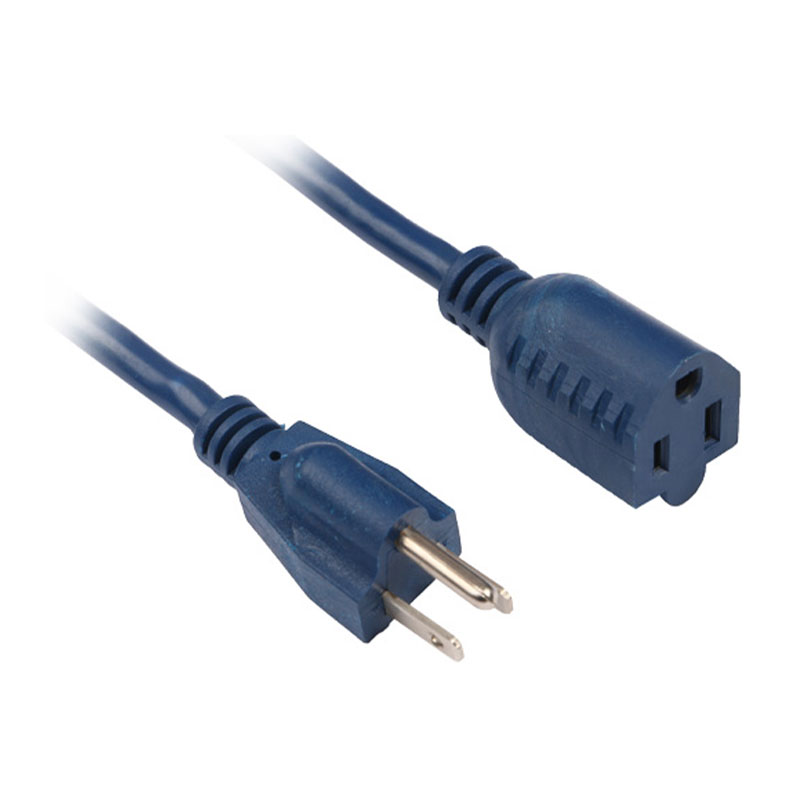 FP-672 Durable Orange Grounded Outdoor Extension CordThis heavy-duty orange cord offers grounded 3-prong connections and a thick jacket, making it a solid choice for temporarily powering high-current appliances like microwaves when used as the sole device on the line.View Product →
Before buying, also confirm that the extension cord is not attached to a power strip or surge protector that directs power to multiple sockets. A microwave should be the only appliance on the cord. For broader guidance on how extension cord ratings apply to different appliances, review our extension cord application notes for electrical appliances.
Best Practices for Plugging a Microwave Into an Extension Cord Safely
Even the right extension cord can become dangerous if it is used incorrectly. Follow this simple sequence every time you need to connect a microwave to an extension cord.
- Unplug the microwave and inspect both the microwave’s power cord and the extension cord for cuts, melted spots, or loose plug blades before connecting anything.
- Plug the microwave’s cord firmly into the extension cord first, then plug the extension cord directly into the wall outlet. This reduces arcing at the last connection point.
- Uncoil the full length of the extension cord before use. A coiled cord creates a concentrated area of heat that can melt insulation.
- Make sure no other appliance, light fixture, or charging device is connected to the same extension cord or to the same wall outlet while the microwave is running.
- After five minutes of operation, feel the extension cord near the plug and along its length. It should be warm but not hot. If it is hot to the touch, unplug the microwave immediately and upgrade the cord or relocate the microwave.
- Do not route the cord under carpets, through doorways, behind furniture, or anywhere it can be stepped on, pinched, or abraded.
Final Verdict
Yes, you can plug a microwave into an extension cord if the cord is a heavy-duty grounded type with conductors large enough to carry the microwave’s full operating current. For most 120 V countertop microwaves, that means at least 14 AWG, and preferably 12 AWG if the cord is longer than a few feet. The cord must have a three-prong plug, must be rated for at least 15 A, and must be used as a temporary connection only.
If you have an older kitchen with only one or two outlets, the permanent solution is to add a dedicated microwave receptacle. An extension cord is a workaround, not a replacement for a proper kitchen circuit. When in doubt, err on the side of thicker wire and shorter length. For more technical guidance on matching cord ratings to heavy electrical loads, see our article on selecting the right power cord for industrial applications.
Latest Updates
Provide You With The Latest Enterprise
Provide You With The Latest Enterprise
and Industry News.
We will continue to focus on the intelligent temperature control field and serve global users with technical concepts of "safer, more energy-efficient and more environmentally friendly".
-
Industry News
The Ultimate Guide to Immersion Water Heaters: From Portable Heating to Safety Best Practices
11
Feb 2026
Be the First to Know
For exclusive deals and latest offers, sign up by entering your email address below.
-

Provide one-stop service from design optimization, process improvement to volume delivery.
-
Quick Links
Home Products About Us Advantages Application News Contact Us -
Products Categories
Immersion Water Heater Extension Cord Power Strip Power Cord Heating Element Hot Plate Magnesium Anode Rod Electrical Water Heater Stem Thermostat -
Contact Information
Add : Feida Industrial Park , Houxiang Town, Danyang City , Jiangsu Province ,China
E-mail: gm@cnfpdq.com
Tel: +86-13306103666
Fax: +86-511-86321126
Copyright © 2025 by Danyang Feipeng Electrical Appliance Co., Ltd. All Rights Reserved.
 Custom Electric Heater Components Manufacturers
Custom Electric Heater Components Manufacturers