

 English
 русский
 Español
 عربى
عربىDon't hesitate to send a message

Can You Plug a Microwave Into an Extension Cord? Safety Rules Explained
Content
- 1 What a Microwave Oven Actually Draws from the Outlet
- 2 Why the Ordinary Extension Cord in Your Drawer Is a Bad Match
- 3 The Three Conditions for Plugging a Microwave into an Extension Cord
- 4 Power Strips and Multi-Outlet Cords: Why the Extra Outlets Are a Risk
- 5 How a Manufacturer Verifies a Microwave-Ready Extension Cord
- 6 Voltage, Plug Standards, and How the Answer Changes by Region
- 7 Safer Alternatives That Eliminate the Extension Cord
- 8 The Safety Checklist That Decides the Answer
You bring home a new microwave, slide it onto the counter, and discover that its moulded power cord stops about 40 centimetres short of the wall outlet. In that moment, the quickest fix is the one most people already own: an extension cord pulled from a drawer, a toolbox, or the back of a closet. Whether that fix is safe depends entirely on the wire gauge, the length, the grounding, and the amp rating of the cord, plus the actual power draw of the oven itself.
Here is the direct answer before we unpack the details: a microwave oven can be plugged into an extension cord, but only when the cord is a heavy-duty, three-prong grounded type rated for at least 15 amperes in a 120-volt region, when the cord is kept as short as practically possible, and when the arrangement is recognised as a temporary connection rather than a permanent substitute for a wall receptacle. If the cord in hand is a thin two-prong type, a long 16-gauge reel, or an unmarked promotional item with no certification mark, the safe answer is no.
That conclusion holds for every type of microwave, from a compact 700-watt dorm room oven to a 1,500-watt over-the-range unit, though the margin of safety changes a great deal between them. The rest of this article explains the electrical calculations behind that answer, what to check on the cord itself, why power strips deserve extra caution, and how the answer changes in 230-volt countries.
What a Microwave Oven Actually Draws from the Outlet
Understanding whether an extension cord is acceptable starts with the appliance, not the cord. A microwave oven has two power figures printed on its nameplate: the cooking power, which is the microwave energy delivered to the food, and the input power, which is the total electrical power consumed from the wall. Cooking power is always lower than input power because the magnetron, the high-voltage transformer or inverter, the cooling fan, the turntable motor, the display, and the control board all consume electricity that never reaches the food.
Take a common 1.2-cubic-foot microwave in North America. It may advertise 1,100 watts of cooking power, but its nameplate input rating will typically sit between 1,400 and 1,600 watts. Since electrical current in amperes equals power in watts divided by voltage, that range at a nominal 120-volt supply means 11.7 to 13.3 amperes. A larger over-the-range unit with 1,200 watts of cooking power can easily draw 1,800 watts and 15 amperes at 120 volts, which is already at the limit of a standard 15-amp household circuit.
The voltage side of the calculation changes the danger profile completely. A 230-volt supply cuts the current in half: the same 1,500-watt input that means 12.5 amperes in the United States draws only about 6.5 amperes in the United Kingdom, continental Europe, Australia, or South Africa. This is why much of the online discussion about microwave extension cords sounds contradictory; recommendations that are absolute warnings in North America are often casual "yes, it works fine" answers in 230-volt countries. Both groups are describing the same appliance physics through different regional lenses.
There is another electrical factor that does not appear on the nameplate: the starting surge. When a microwave starts a heating cycle, the magnetron and its high-voltage supply draw a transient current that can be two to three times the steady-state value for the first few milliseconds. A properly sized cord handles this brief surge without difficulty. An undersized cord, however, experiences a measurable voltage drop during the surge, which can make the oven's internal power supply work harder, reduce heating performance, and generate heat inside the cord's own conductors.
The internal power supply technology also matters for how the oven behaves on a weak connection. Older designs use a large 60-hertz transformer that is relatively tolerant of voltage sag. Newer inverter-based models regulate microwave power electronically and may draw a steadier but more demanding current profile. Neither type should be starved of voltage by a long thin extension cord, because the appliance is protected by its own fuses and thermal cutouts, not by the cord supplying it.
| Microwave category | Typical input power | Current at 120 V | Current at 230 V | Extension cord requirement at 120 V |
|---|---|---|---|---|
| Compact (0.6-0.9 cu ft) | 900-1,100 W | 7.5-9.2 A | 3.9-4.8 A | 14 AWG grounded, 15 A rated |
| Mid-size (1.0-1.3 cu ft) | 1,100-1,500 W | 9.2-12.5 A | 4.8-6.5 A | 14 AWG grounded, 15 A rated |
| Large countertop (1.4-1.7 cu ft) | 1,400-1,800 W | 11.7-15.0 A | 6.1-7.8 A | 12 AWG grounded, 20 A rated recommended |
| Over-the-range / commercial | 1,600-2,200 W | 13.3-18.3 A | 7.0-9.6 A | No extension cord; use a dedicated outlet |
The nameplate is the only number that matters for cord selection. If the plate is hard to read because the oven sits on a shelf, unplug the unit and check the back panel before you decide anything. The cooking-power number on the front of the oven is not the current draw. A microwave with a 1,200-watt cooking power label and a 1,800-watt input rating needs a cord sized for the larger value, which is small but non-negotiable difference.
Why the Ordinary Extension Cord in Your Drawer Is a Bad Match
Most extension cords found in homes are light-duty cords designed for lamps, phone chargers, radios, or other small loads. Their conductors are typically 16 AWG or 18 AWG. In the American Wire Gauge system, the smaller the number, the larger the copper conductor and the higher the current capacity. An 18 AWG cord carries about 7 to 10 amperes depending on its jacket and length; a 16 AWG cord carries roughly 10 to 13 amperes. A microwave that draws 12.5 amperes on a continuous heating cycle is simply too large for most 16 AWG cords and every 18 AWG cord.
The problem is heat. When current flows through a conductor, power is dissipated as heat proportional to the square of the current multiplied by the resistance. That is the I²R relationship. If a 16 AWG extension cord has enough resistance to drop just half a volt per metre of its length, the heat builds up inside the jacket every time the magnetron runs. The oven runs for two or three minutes per heating cycle, then sits idle; over an afternoon of reheating coffee, soup, lunch, and dinner, the cord accumulates thermal stress that the thin layers of PVC insulation were not designed to shed.
Length makes the situation worse. Resistance is directly proportional to length. A 6-foot 16 AWG extension cord may just barely cope with a small 700-watt microwave. A 25-foot version of the same 16 AWG cord at 10 amperes can lose more than 4 volts under load, which is enough to make the microwave's internal components run at low line voltage while the cord itself becomes warm. At 12 amperes, the voltage drop and the heating are significantly worse. This is why electrical guidance consistently says that if an extension cord is absolutely necessary, it must be the shortest one that reaches.
There is also a construction quality gap. Light-duty cords often use copper-clad aluminium wire instead of solid pure copper, aluminium-clad plugs with thin blades, and soldered joints that add resistance. The jacket material may be labelled only with a vague voltage rating and no current rating at all. If the cord does not carry a clear specification on the outer jacket, such as 16/3 SJTW or 14/3 SJOOW, treat it as unsuitable for a microwave. The first number is the gauge, the second is the number of conductors, and the letters describe the jacket service rating; all three pieces of information should be printed on any cord worth trusting.
Another common mistake is assuming that because the microwave runs for only a few minutes at a time, the duty cycle will save a thin cord. That logic ignores the fact that the electrical stress exists for the entire duration of the heating cycle, not just at the moment the oven is switched on. A cord that is 20 percent overloaded for three minutes will produce roughly 44 percent more heat than a correctly loaded cord in that same period. The dishwasher, kettle, and refrigerator on the same kitchen circuit also create voltage conditions that make an undersized extension cord work even harder.
| Conductor gauge | Typical ampacity (short length) | Compatible with a microwave? |
|---|---|---|
| 18 AWG | 7-10 A | No. Only tiny 500-700 W ovens at very short length; not recommended. |
| 16 AWG | 10-13 A | Marginally acceptable for a 700 W oven under 6 ft; generally not recommended. |
| 14 AWG | 15-18 A | Yes, for most countertop microwaves up to 1,500 W input, under 10 ft and grounded. |
| 12 AWG | 20-25 A | Yes, best choice for long runs or over-range units at the high end of the range. |
One more mistake appears repeatedly in user discussions: coiling a long cord that "will not be used fully extended". Coiling concentrates the heat generated by the conductor into a small area and adds inductive effects that raise the temperature further. A cord rated for 15 amperes but wound into a tight coil can overheat at half that current. If a long cord must be used, uncoil the entire length even if the excess loops lie on the countertop. The same applies to cords tucked behind a cabinet or pulled tight around a corner; every pinch point becomes a location where the insulation is thinner and the heat cannot escape.
The Three Conditions for Plugging a Microwave into an Extension Cord
If the decision is made to use an extension cord, the decision should be based on three verifiable conditions being satisfied at the same time. Complete all three checks before you connect the microwave.
Condition 1: The cord must be grounded, three-prong, and rated for at least 15 amperes
The microwave has a three-prong grounding plug for a reason. The chassis of the oven is bonded to the ground path so that a fault in the internal high-voltage section routes through the ground wire instead of through the person touching the metal body. A two-prong "cheater" cord or a three-prong-to-two-prong adapter removes that protection. The cord must be a three-conductor cord with a continuous ground wire from the appliance plug to the receptacle.
The current rating printed on the cord's jacket must be at or above the full-load nameplate amperage of the microwave. In North America, that means 15 amperes minimum for most countertop units, and 20 amperes for units whose nameplate is close to 15. A cord rated exactly at the appliance's nameplate current has no margin for the starting surge or for house voltage that runs low; choose the next size up whenever possible. The one product category that frequently meets this specification is a purpose-built household appliance cord rather than a decorative extension lead.
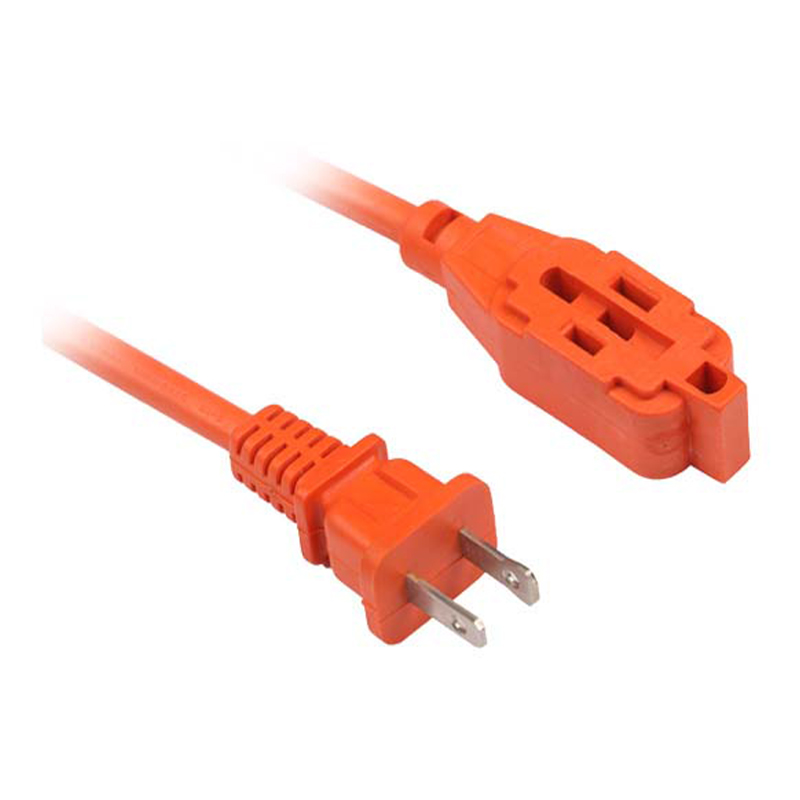
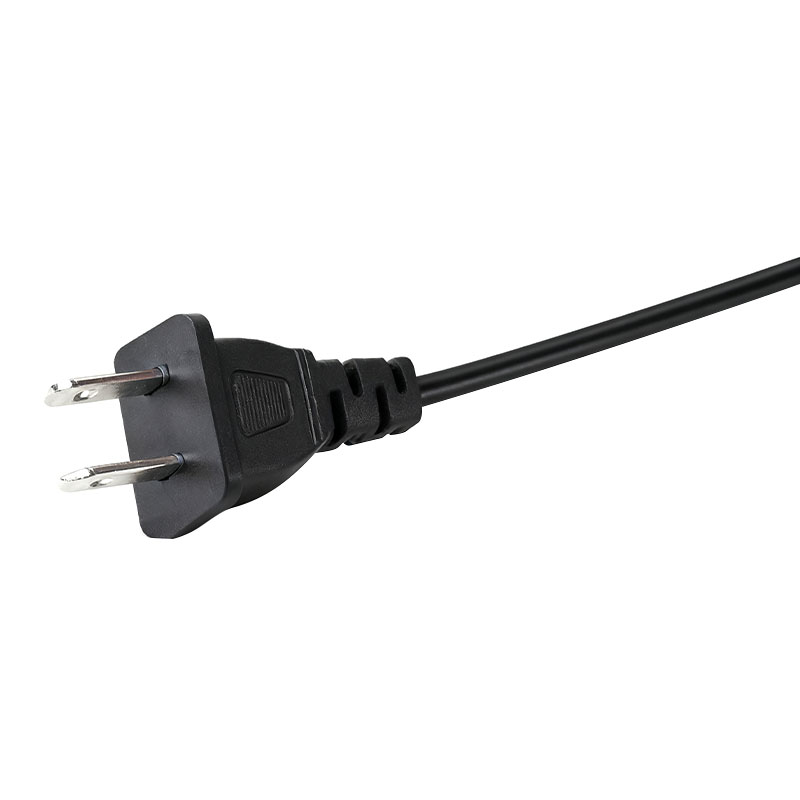
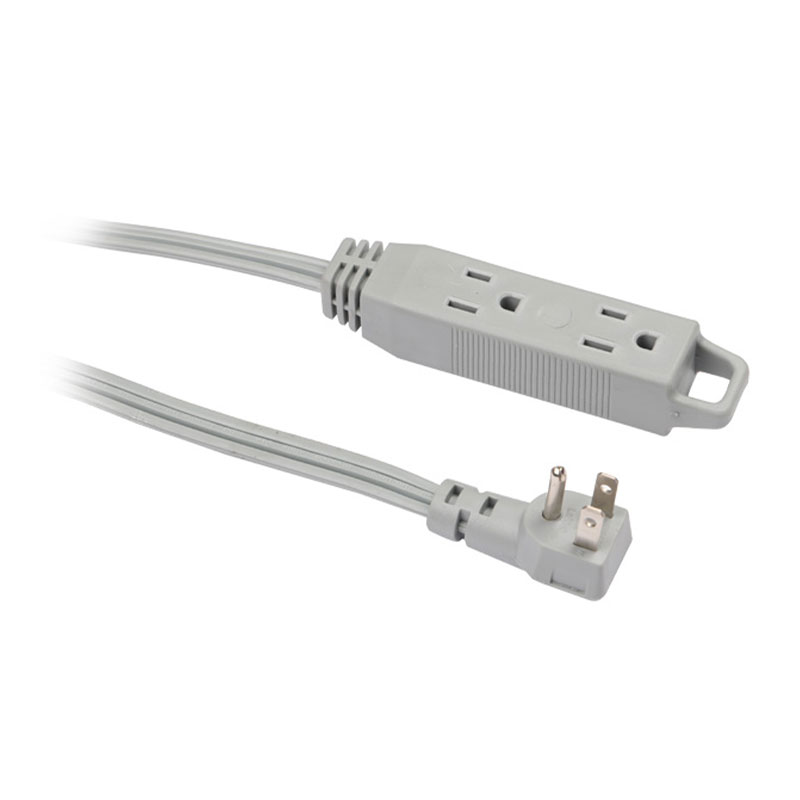 American Standard Household Multi-Outlet Extension Cord with Two-Prong PlugThis multi-outlet cord with a two-prong US plug is rated for household appliance loads, making it a candidate for temporarily powering a microwave when used as the sole connected load. Its PVC construction and multiple outlets suit basic home use.View Product →
The household multi-outlet cord shown in the card above is an example of a proper American-standard construction: a grounded plug, multiple outlets, and internal conductors selected for a rated load rather than for lamp duty. It is electrically capable of feeding one microwave, but the extra outlets carry a temptation. If you are using a multi-outlet cord, the microwave must be the only appliance connected. The total current through every conductor inside the cord is what matters, and the conductor does not care which appliance supplied the current.
Condition 2: The cord must be the shortest practical length
Every additional metre of cord adds resistance, voltage drop, and heat. Kitchen guidance from qualified electricians and electrical inspectors consistently points to a heavy-duty, grounded cord rated for at least 15 amperes and kept as short as possible. Six feet is reasonable; ten feet with a 14-gauge cord is the practical outer limit for a full-size countertop microwave. If the microwave cannot be reached by a ten-foot 14-gauge cord, the correct solution is not a 25-foot 12-gauge cord lying across the counter; it is a repositioned appliance or a new wall outlet.
Condition 3: The cord must be visually and mechanically sound
Inspect the full length of the cord just as a factory inspector would. Look for cuts, twisted insulation, pinched sections, burn marks, or a plug whose blades are loose, bent, or darkened. The plug must seat firmly in the receptacle with no wobble, and the strain relief where the cord enters the plug and the connector must be intact. A damaged cord fails even when its gauge and rating are otherwise correct, because the damage introduces a high-resistance point that becomes the hottest spot in the circuit.
All three conditions apply to temporary use only. The National Electrical Code and most local electrical regulations treat extension cords as temporary wiring. They are not permitted as a permanent replacement for a wall outlet, and they must not be routed through walls, under floors, or along baseboards. If the microwave lives on the counter and the cord is plugged into an extension cord every day for a year, that installation is unambiguously against code regardless of how good the cord is. Electrical inspectors look for exactly this pattern when they investigate kitchen fires and insurance claims.
There is one additional subtlety that many users miss: the protection devices on the circuit. If the wall receptacle is protected by a ground-fault circuit interrupter or an arc-fault circuit interrupter, the presence of a long extension cord can increase the chance of nuisance tripping. An AFCI may interpret the arcing inside a worn cord as a genuine fault, and a GFCI may trip on the small leakage current that an old cord allows through its damp jacket. A nuisance trip in the middle of a heating cycle is annoying, but it is also a useful warning that the cord is not in good condition.
Power Strips and Multi-Outlet Cords: Why the Extra Outlets Are a Risk
Power strips are the second most common solution for a microwave that does not reach an outlet, and they deserve their own warning. A typical power strip is not designed as an appliance cord. It is a convenience device for multiple low-power electronics. Inside many strips, the conductors are 16-gauge and the unit is rated 13 or 15 amperes in total across all outlets, not per outlet. The data sheet on the packaging usually says "connected load not to exceed the rating marked on the unit", but users rarely read it before plugging in a microwave, a coffee maker, and a toaster.
There is also the surge-protection layer. Many strips contain metal-oxide varistors, or MOVs, which clamp voltage spikes. MOVs degrade every time they absorb a surge, and their failure mode is not always a clean shutoff. When a strip contains both a microwave and other loads, the strip's internal protection circuit can also nuisance-trip, interrupting the microwave in the middle of a cycle, or the cumulative current can exceed the strip's rating even though each individual appliance is below its own rating. A microwave that loses power mid-cycle due to a tripped strip is not merely a cooking inconvenience; repeated interruptions can stress the electronic control board, which is a far more expensive failure than a ruined meal.
Electrical inspection bodies across North America publish the same warning: major appliances such as microwaves, space heaters, refrigerators, and washing machines should be plugged directly into a wall receptacle, not into a power strip. A microwave oven is a major appliance when it draws double-digit amperes. The warning is not about the plug shape; it is about the cumulative conductor load and the absence of a dedicated circuit path. The kitchen counter circuits are designed for high loads, but those circuits were designed for the appliances to be plugged directly into the receptacles, not through an additional layer of cord and sockets.
If you understand all of that and still need the multiple outlets for other kitchen appliances while temporarily feeding the microwave, then the strip itself must carry the same heavy-duty specification as a microwave-rated extension cord: a grounded three-prong plug, 14-gauge or larger conductors, and a marked 15-ampere rating. That specification is rare in retail strips, but it exists. One product from our range that meets this heavy-duty specification is the US-standard power strip with multiple outlets and a rocker switch, shown in the card below.
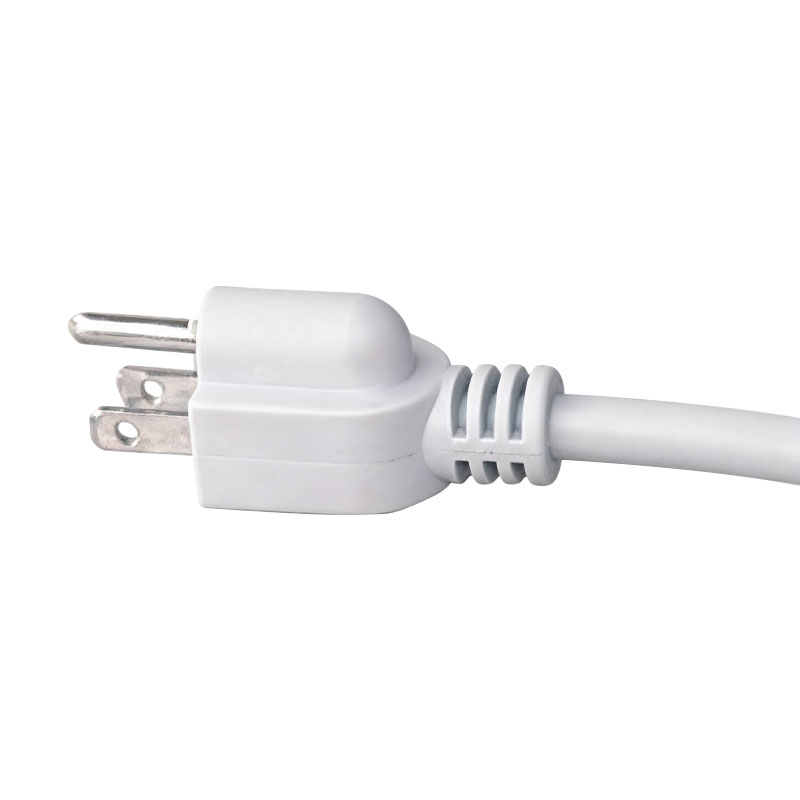 US Standard Power Strip with Multiple Outlets and Rocker SwitchThis power strip offers four or six outlets, a red rocker switch with indicator light, and overload protection. Its flame-retardant housing and 10A rating make it a heavy-duty option for temporarily powering a microwave alongside other devices, provided the microwave is the primary load.View Product →
The same rule applies as with any extension cord: connect the microwave as the only load on the strip, never run a second high-draw appliance through the strip at the same time, and treat the setup as a temporary measure. When the countertop outlet project finally happens, the strip should go back to powering a phone charger and a desk lamp.
How a Manufacturer Verifies a Microwave-Ready Extension Cord
From a factory perspective, the difference between a safe and an unsafe extension cord is not the brand printed on the jacket. It is a set of measurable specifications that determine how the cord behaves under load. Our facility has produced heating components and power connection products since 1990, including household extension cords, outdoor cords, and region-specific power cords, which gives us a direct view of where cheap construction fails and where quality matters for an appliance like a microwave.
Conductor material and gauge are the starting point
The conductors must be pure copper or a high-quality copper alloy with the correct cross-sectional area. Copper-clad aluminium is cheaper and lighter, but it has higher resistance per metre and is more prone to heating at connection points; it has no place in a microwave circuit. The gauge marking on the jacket should match the actual conductor. In a 14/3 SJTW cord, the "14" means 14 AWG conductors, the "3" means three conductors (line, neutral, ground), and the "SJTW" describes the service type, the jacket material, and the weather rating. A cord carrying only a vague "250 V" marking without an AWG number should be treated with suspicion.
Moulded plugs and strain relief prevent the invisible failures
A good cord has a moulded-on plug whose blades are thick, flat, and firmly aligned. The blades should be nickel-plated or at least corrosion-resistant so the contact resistance at the receptacle stays low. The strain relief where the cable exits the plug body must be part of the moulding or a tight-fitting sleeve; a cord whose plug is merely glued or clipped onto the end can pull apart internally and create an arcing connection. The same standard applies to the female connector on the other end, and to the socket housings inside a multi-outlet cord.
The jacket must be rated for the environment and the temperature
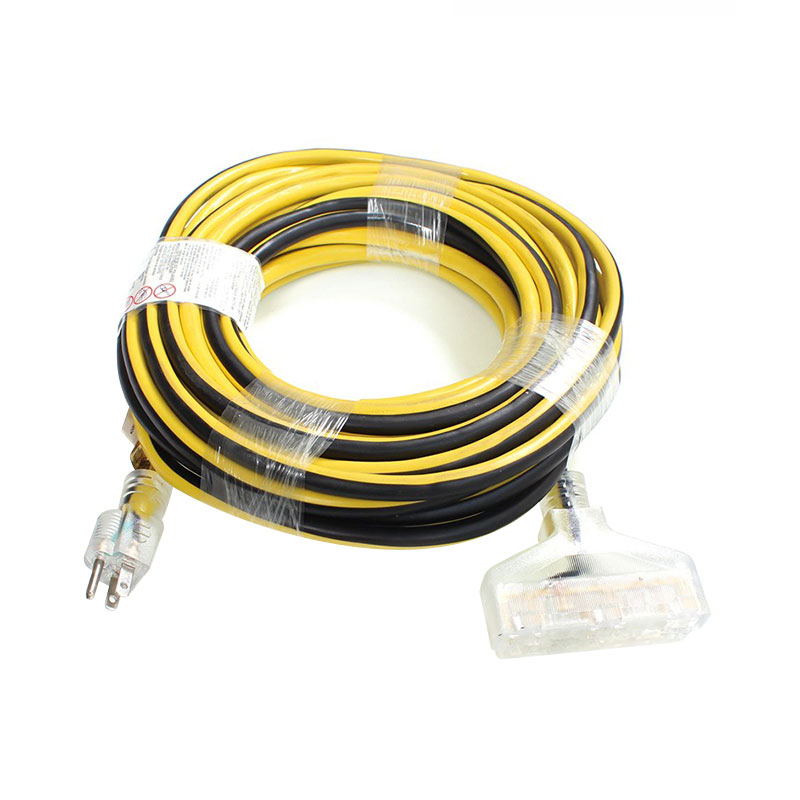
Kitchen use means the cord may sit near heat from the oven, steam from the kettle, and foot traffic across the floor. A standard light-duty PVC cord rated for lamp use has insulation that softens when warm. A service-rated cord such as SJTW or SJOOW has a thicker thermoplastic jacket that withstands moisture, abrasion, and higher ambient temperature. Outdoor-rated cords such as the FP672 heavy-duty orange cord add a tough, highly visible jacket and a grounded three-prong connector, which makes them acceptable for temporary power in workshops and temporary sites as well as kitchens. The card below shows this outdoor cord as an example of a cord built with the same heavy-duty design language.
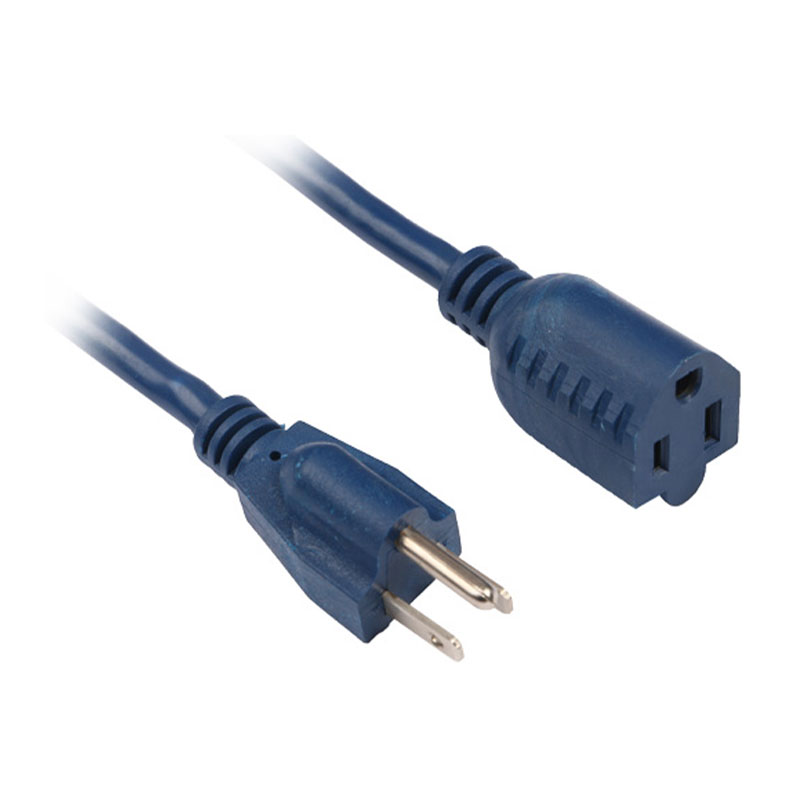 Durable Orange Outdoor Extension Cord with Grounded 3-Prong PlugThis bright orange extension cord features a grounded three-prong plug and receptacle, built with weather-resistant PVC for visibility and durability. Its service-rated jacket suits workshops, kitchens, and sheltered outdoor use, offering a heavier-duty alternative to light-duty lamp cords.View Product →
Certification marks are the buyer's only independent proof
In North America, look for a UL Mark, an ETL Mark, or a CSA Mark on the cord. These marks mean a recognised testing laboratory has sampled and tested the design. In Europe, the equivalent marks include VDE, TÜV, and the harmonised cable designation printed on the jacket, such as H05VV-F 3G1.5, which identifies a 1.5-square-millimetre three-core cable suitable for appliances up to 16 amperes at 230 volts. A cord with no certification mark has undergone no independent verification, and its claimed rating is just a printed promise.
In our own production line, every cord that leaves the factory is checked for conductor continuity, correct polarity, insulation resistance, and mechanical integrity of the moulded plug before it is packed. These are not exotic tests; they are the minimum checks that any buyer should expect from a supplier. The selection logic for a microwave cord is identical to the logic used by engineers who specify power cords for industrial equipment. Determination of load, selection of conductor cross-section and jacket, verification of certification, and a limit on cable length are universal steps covered in more depth in our guide to selecting the right power cord for industrial applications.
Voltage, Plug Standards, and How the Answer Changes by Region
The answer to "can you plug a microwave into an extension cord" changes when the question moves across a border. In the United States and Canada, the household supply is nominally 120 volts and a full-size microwave draws 10 to 15 amperes. In countries with a 220-240-volt supply, the same microwave oven draws roughly half of that current because power equals voltage multiplied by current. A 1,100-watt oven that needs 12.5 amperes at 120 volts needs only 5.7 amperes at 230 volts.
That difference is why UK electrical forums treat the question with relative calm. A common UK extension lead with a BS 1363 plug and a 13-amp fuse is usually built with 1.5-square-millimetre conductors, which in the harmonised European system is rated for 16 amperes at 230 volts. Plugging a 1,000-watt microwave into such a lead leaves roughly 70 percent of the lead's capacity unused. The same setup in a 120-volt country would be dangerous because the wire would carry twice the current for the same wattage.
That does not mean every extension lead in a 230-volt country is safe. Discount-store leads and older leads can use 0.75-square-millimetre or 1.0-square-millimetre conductors historically rated for lamp duty, and a 3,000-watt microwave with a 13-ampere current would overload them even at 230 volts. The rule is universal: verify the lead's current rating, its fuse where applicable, and its conductor cross-section against the nameplate current of the microwave, and never assume that "European voltage means no risk".
| Region | Nominal voltage | Plug standard | Typical extension lead rating | Current for a 1,100 W input microwave |
|---|---|---|---|---|
| United States / Canada | 120 V | NEMA 5-15 | 15 A, often 16 AWG in light-duty cords | 9.2-12.5 A |
| United Kingdom / Ireland | 230 V | BS 1363, 13 A fuse | 13 A, 1.5 mm² typical | 4.8 A |
| Continental Europe | 230 V | CEE 7/4 or CEE 7/7 | 16 A, 1.5 mm² typical | 4.8 A |
| Australia / New Zealand | 230 V | AS/NZS 3112 | 10 A, 1.0-1.5 mm² typical | 4.8 A |
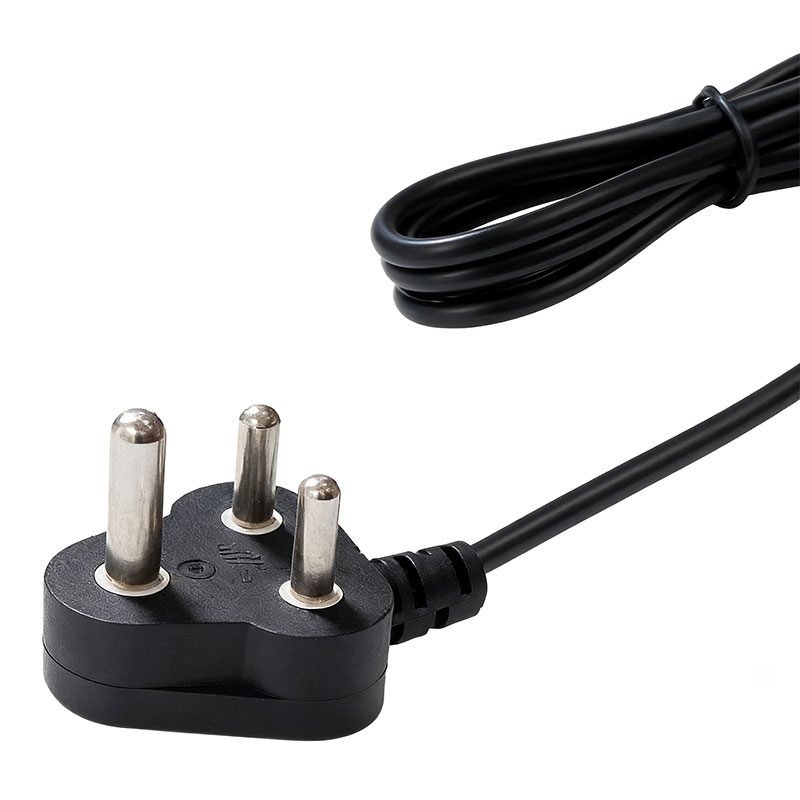
| South Africa | 230 V | SANS 164 | 16 A, 1.5 mm² typical | 4.8 A |
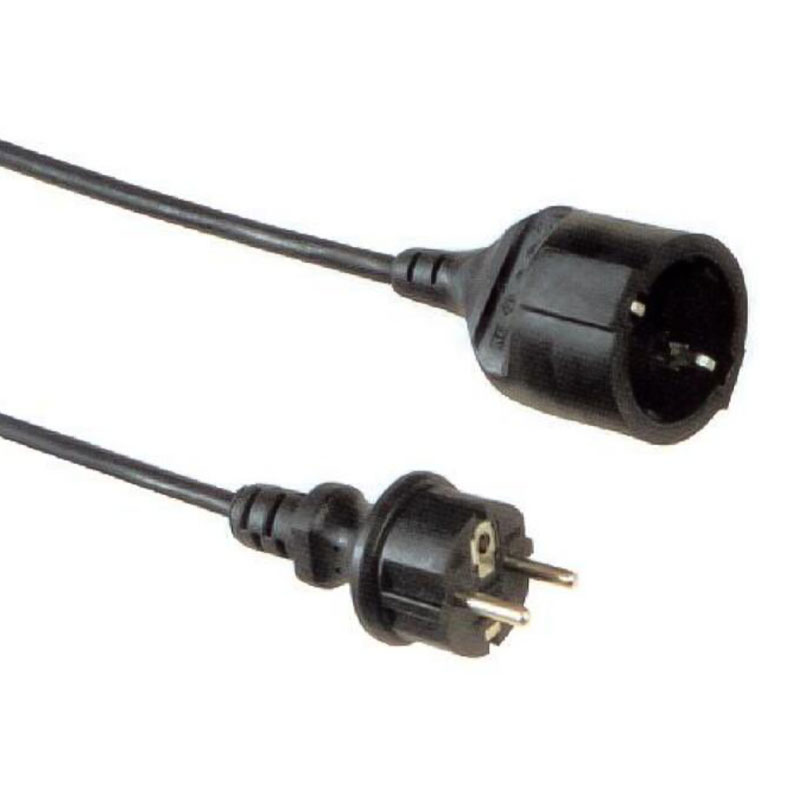
Plug geometry is another variable. A North American NEMA 5-15 plug is rated 125 volts and 15 amperes, so an appliance rated 13 amperes fits it. A Schuko plug in continental Europe is unpolarised, while UK and Australian plugs are fused or otherwise protected per local standards. Extension cords that cross borders must match the local plug and voltage system; a European 230-volt microwave with a European plug cannot simply be adapted to a US 120-volt outlet with a passive adaptor because the oven is designed for a different voltage class. This is precisely why manufacturers build region-specific power cords, a point covered in our application overview of extension cords for various electrical appliances.
Safer Alternatives That Eliminate the Extension Cord
A correctly chosen extension cord is a workaround, not a solution. The permanent solution to a microwave that cannot reach its power source is one of the following options, arranged roughly by cost and effort.
Add a wall outlet in the optimal counter position
Kitchen countertop receptacles in North America are required to be on one of at least two 20-ampere small-appliance branch circuits, and the outlets themselves are placed so that no point on the counter is more than four feet from an outlet. If your kitchen was built before that rule and the microwave outlet is on the wrong wall, a licensed electrician can run a new branch circuit or extend the existing counter circuit to a more convenient position. This is the only code-compliant permanent answer to the problem.
Move the microwave to a location near an outlet
It sounds obvious, but buyers are often attached to a particular counter spot because of visual layout rather than electrical access. A microwave does not need to be the most prominent appliance in the kitchen. Moving it to a shelf or cabinet that puts the plug within four feet of an outlet removes the need for an extension cord entirely, at zero cost. Renters in particular should try this first, because modifying the electrical wiring of a leased property usually requires the landlord's permission and a licensed contractor.
Install a dedicated circuit for over-the-range units
Over-the-range microwaves combine oven ventilation with high microwave power and frequently draw 15 amperes or more. The manufacturer's installation manual almost always specifies a dedicated grounded outlet on a separate circuit. Do not feed an over-the-range unit through any kind of extension cord, because the unit runs the fan, the lights, and the magnetron from the same supply, and the continuous ventilation duty makes the thermal load worse than a countertop oven that cycles off.
Understand the boundary between temporary and permanent
Every electrical code in the world treats the extension cord as a temporary device. The US National Electrical Code, specifically NEC 400.8, prohibits using flexible cords as a substitute for fixed wiring. The same prohibition exists in the IET Wiring Regulations in the UK. So a heavy-duty cord used for the two weeks between moving the counter and hiring the electrician is defensible; the same cord installed behind the cabinet, hidden from view and planned as the permanent feed, is exactly the installation the code forbids. If the microwave has never once been plugged directly into a wall receptacle since you bought it, the installation is wrong even if it has been running for a year without an incident.
Use the RV and temporary-site exemption for what it is
Caravans, construction site offices, market stalls, and temporary catering tents have no fixed kitchen wiring, which is precisely the condition an extension cord is designed for. In those environments, a certified heavy-duty cord rated above the microwave's current draw is a legitimate tool, provided the supply itself is protected by an appropriate circuit breaker and residual-current device. The same heavy-duty cord used every day in the same kitchen becomes a code violation because the condition is no longer temporary.
The Safety Checklist That Decides the Answer
Here is the complete decision process in the order it should be run next time someone asks whether their microwave can use an extension cord.
- Read the microwave nameplate. Record the input wattage or the input amperage, not the cooking power. Do not proceed without this number.
- Check whether the outlet is on a 15-amp or 20-amp circuit. A microwave near the limit of its circuit is already a risk; adding a long extension cord makes it worse.
- Verify the extension cord's jacket. It must state a gauge of 14 AWG or lower, meaning a thicker conductor, a rating of 15 amperes or higher at 120 volts, and a grounding conductor. In 230-volt countries, it must state a cross-section of at least 1.5 square millimetres and a rating of 13 amperes or higher.
- Confirm the cord is three-prong grounded and physically undamaged. Reject any two-prong cord, any adapter, any twisted or pinched section, and any plug that does not seat firmly in the receptacle.
- Measure the distance. If the necessary length is more than ten feet, choose a shorter appliance position or a new outlet instead of a longer cord.
- Use the cord only for the microwave. A multi-outlet cord with other kitchen appliances running simultaneously does not qualify even if the cord itself is rated correctly.
- Uncoil the cord fully. Never staple, nail, or conceal it under a rug, a countertop edge, or inside a cabinet.
- Monitor the plug and the cord for heat during the first heating cycles. A warm plug face, soft insulation, or a burnt smell means the cord is overloaded; stop using it immediately and install a real outlet.
The straight answer remains the one given at the top: yes to a certified, grounded, heavy-duty cord of the correct gauge and short length; no to everything else. A microwave that beats the cookie-cutter advice by running fine on a light-duty cord is still sitting on a conductor that has been chosen without a safety margin. The margin, not the brand, is what separates a temporary workaround from an electrical fire waiting for the busiest dinner of the year.
Latest Updates
Provide You With The Latest Enterprise
Provide You With The Latest Enterprise
and Industry News.
We will continue to focus on the intelligent temperature control field and serve global users with technical concepts of "safer, more energy-efficient and more environmentally friendly".
-
Industry News
The Ultimate Guide to Immersion Water Heaters: From Portable Heating to Safety Best Practices
11
Feb 2026
Be the First to Know
For exclusive deals and latest offers, sign up by entering your email address below.
-

Provide one-stop service from design optimization, process improvement to volume delivery.
-
Quick Links
Home Products About Us Advantages Application News Contact Us -
Products Categories
Immersion Water Heater Extension Cord Power Strip Power Cord Heating Element Hot Plate Magnesium Anode Rod Electrical Water Heater Stem Thermostat -
Contact Information
Add : Feida Industrial Park , Houxiang Town, Danyang City , Jiangsu Province ,China
E-mail: gm@cnfpdq.com
Tel: +86-13306103666
Fax: +86-511-86321126
Copyright © 2025 by Danyang Feipeng Electrical Appliance Co., Ltd. All Rights Reserved.
 Custom Electric Heater Components Manufacturers
Custom Electric Heater Components Manufacturers